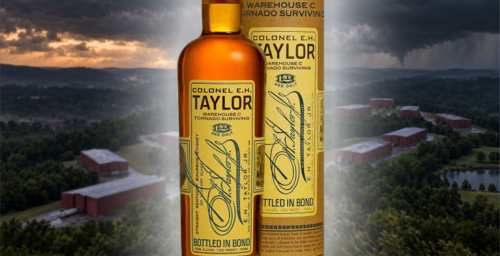
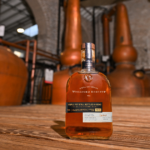







On the evening of April 2, 2006, a storm with tornado-strength winds hit Buffalo Trace Distillery in Frankfort, Kentucky. According to Robin Robinson’s American Whiskey, it ripped the roof off Warehouse C, a brick rickhouse built under Colonel E.H. Taylor Jr. in 1881.
You might expect a story like this to end with a pile of ruined barrels, but the bourbon resting on the warehouse’s top floors actually went on to become a bottle collectors still chase today.
Buffalo Trace released Colonel E.H. Taylor, Jr. Warehouse C Tornado Surviving Bourbon in 2012, with a suggested retail price of $69.99. Today, bottles regularly list for several thousand dollars at retail, anywhere from $ 6,000 to $ 10,000.
Quick whisky question
Single malt is everywhere, but what does it mean? We want to know what the word “single” means to you. Three quick questions, under a minute.
So, what actually happened to those barrels of bourbon, and what effect did it have on the final product?
How The 2006 Tornado Hit Buffalo Trace Warehouse C
Warehouse C was already a notable building long before the storm. Colonel Edmund Haynes Taylor Jr., a legendary figure in the industry, built it in 1885 while he was running the site as the O.F.C. Distillery. He was reportedly extremely proud of the warehouse, which was designed to optimise air circulation and control maturation.

Sadly, around 120 years later, Warehouse C took a battering. April 2, 2006, saw one of the worst tornado outbreaks in modern US history, with 66 instances over seven states. Tornado-strength winds ripped part of the roof off of Warehouse C in Frankfort.
What Will Whisky Look Like in 2027? Voices from Whisky Live Paris
READ THE STORYMiraculously, though, the barrels remained intact. Rather than move them, the distillery left them in place while repairs went on for several months.
What Did This Do To The Bourbon?
The exposed barrels from Warehouse C spent a Kentucky summer in direct sunlight, with much bigger swings in heat and airflow than usual. This increased the whiskey/wood interaction, pushing the bourbon in and out of the crevices in the cask at a greater rate. Robin Robinson reports that the time spent exposed doubled the expected angel’s share, with evaporation reaching 63.9%.
Left to age once the warehouse was repaired, Buffalo Trace chose 93 barrels from the top two floors for the release and emptied them into a single batch in late 2011. At that point, the youngest barrel was 9 years and 8 months old, and many were 11 years and 11 months old.
The distillery bottled the whiskey under its E.H. Taylor, Jr. label as a bottled-in-bond bourbon at 100 proof, using what it calls its Rye Mash #1 recipe. It was the third release in the E.H. Taylor collection, following the Old Fashioned Sour Mash and the Single Barrel.
Colonel E.H. Taylor Jr. Warehouse C Tornado Surviving Bourbon Tasting Notes and Reviews

So, what did this increased whiskey/wood interaction do to the flavor of the bourbon?
According to Buffalo Trace’s official tasting notes, the nose opens with dried fig and cloves, then baking spice and a dry oakiness. On the palate, the distillery picks out jammy fruit, vanilla and a little smoke, and the finish moves into dark spice and tobacco.
Critics were broadly positive when it came out. John Hansell gave it 90 points in the Summer 2012 issue of Whisky Advocate and summed it up as “Very drinkable for 100 proof, and with plenty of character.” Christopher Null at Drinkhacker was even more enthusiastic, writing that it was “Probably the best Taylor of the three bottlings released so far.”
From $70 to Thousands
When it launched in 2012, Buffalo Trace set a suggested retail price of $69.99, but thanks to its rarity and collectibility, bottles now change hands for thousands of dollars.
At auction, bottles are currently selling for around $3,100-$4,000, with a bottle selling for as much as $8,404 in February 2021. Retailers regularly ask $6,000 plus for the bottle.
Buffalo Trace Warehouse X: Recreating the Storm on Purpose
E.H. Taylor Jr. Tornado Surviving Bourbon was a happy accident born out of tragedy that has become something of an icon in the bourbon community. According to Robin Robinson, though, it actually had far-reaching consequences for Buffalo Trace.
According to Robinson’s American Whiskey, the tornado bourbon was what inspired Buffalo Trace to build Warehouse X in 2013. It’s an experimental warehouse designed to study how the elements affect bourbon while it ages, including what made the Warehouse C Tornado Surviving Bourbon so special.
The building is fairly small, at 30 by 50 feet. Inside are four separate chambers that can each be set up differently, plus an open-air breezeway. Buffalo Trace tests natural light, temperature, humidity, and airflow one at a time, as part of a 20-year project that it expects to produce around 70 million data points.
The first experiment ended in 2016 and looked at natural light. It found that light on its own didn’t change the color or proof of the bourbon.
The second experiment ended in 2019 and focused on temperature. It gathered 9.1 million data points, which the distillery says showed how temperature changes the pressure inside the barrels, along with the whiskey’s color and flavor.
Buffalo Trace then announced a third, two-year experiment looking at how rising and falling temperatures affect the whiskey in the barrel. By October 2020, that experiment had already produced 1.3 million data points.
What The Tornado Surviving Bourbon Taught Buffalo Trace

Nobody at Buffalo Trace wanted a storm to tear open one of its warehouses, but the barrels left sitting under an open sky turned into a bourbon collectors still go looking for today. The accident also pushed the distillery to think much more carefully about how the conditions inside a warehouse shape the whiskey, and that thinking led directly to Warehouse X, which we hope to hear more about in the near future.
Have you ever managed to try a bottle of Warehouse C Tornado Surviving Bourbon, and if not, would you pay what it costs now to find out?
 Latest On The Whiskey Wash