

I’m a whisky person through and through, and while I enjoy a glass of rum every now and then, I know very little about how it’s made. When I think of Islay, I think of peat smoke, warehouses by the sea, and some of Scotland’s best-known single malt distilleries. Rum doesn’t immediately spring to mind.
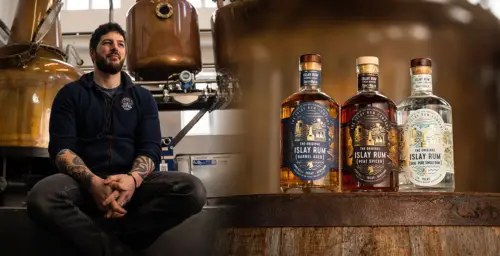
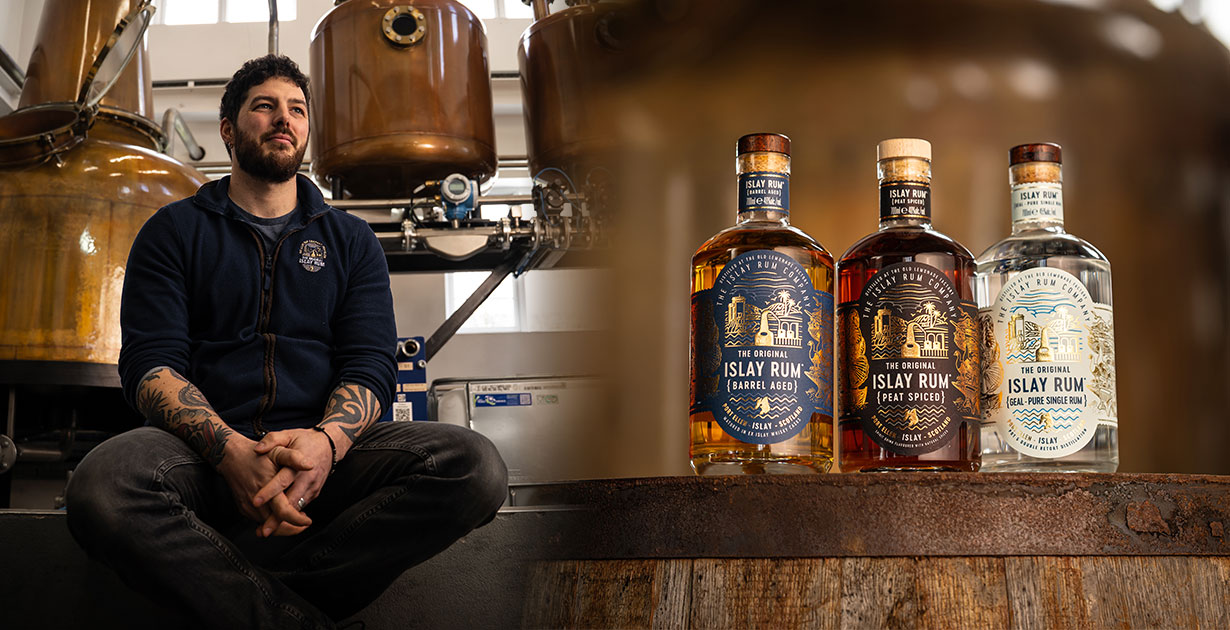
Yet The Islay Rum Company has been producing rum in Port Ellen since 2022, operating the island’s first rum distillery from a restored lemonade factory. I sat down with head distiller and distillery manager Ben Inglis and director Andrew Crook, who also runs parent company The Vintage Malt Whisky Company, to find out what happens when you make rum on an island famous for whisky.
What became clear is that Ben has no interest in recreating Caribbean rum in Scotland. He’s far more interested in discovering what Islay itself brings to the spirit.
What Will Whisky Look Like in 2027? Voices from Whisky Live Paris
READ THE STORYA Whisky Family Meets a Rum Lover
My first question is the obvious one: why would someone who grew up on Islay choose rum over whisky?
“My fault,” Ben says, taking responsibility for steering the company towards rum.
Growing up in Port Charlotte, he was surrounded by whisky distilleries, but rum was always his preference. His fascination with production led him to experiment with home-brewed beer, hedgerow wine and cider made using an apple press he built himself. He later sought advice from distillers in Barbados, the US and across the UK.
 Trending Content

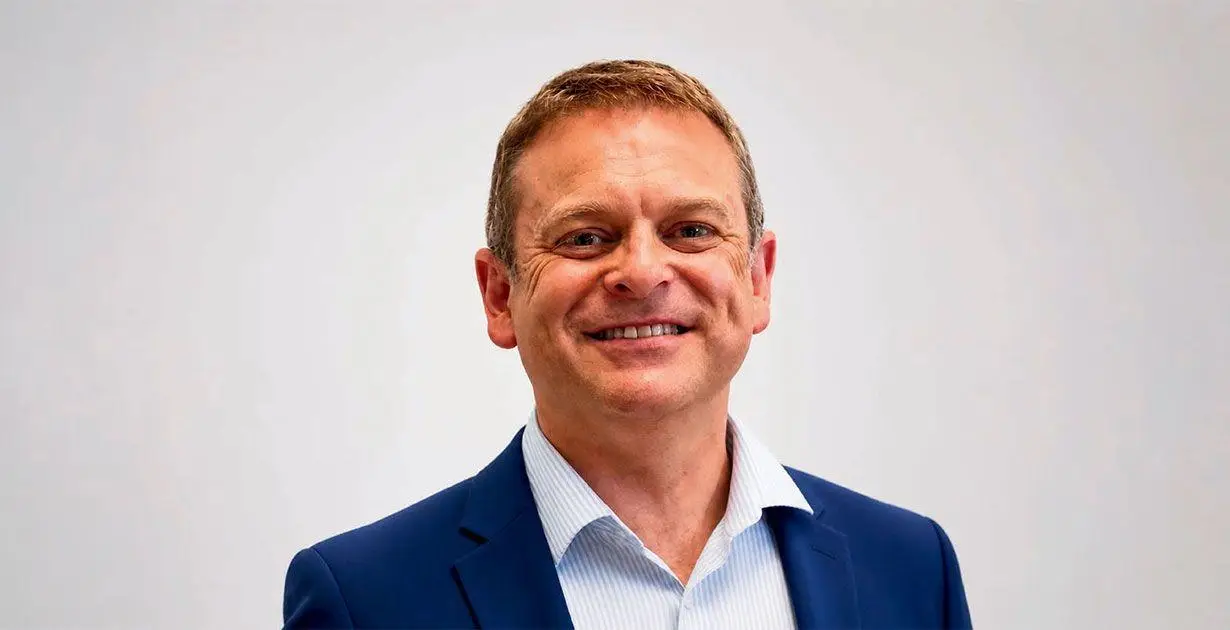
When I ask why he wanted to make rum on Islay, his answer is simple: “coming back to Islay is always coming home for me.”
Andrew’s connections to the island come through whisky. His father, Brian, worked for Bowmore before founding The Vintage Malt Whisky Company in the early 1990s. The business subsequently created the Islay malt brands Finlaggan and The Ileach.
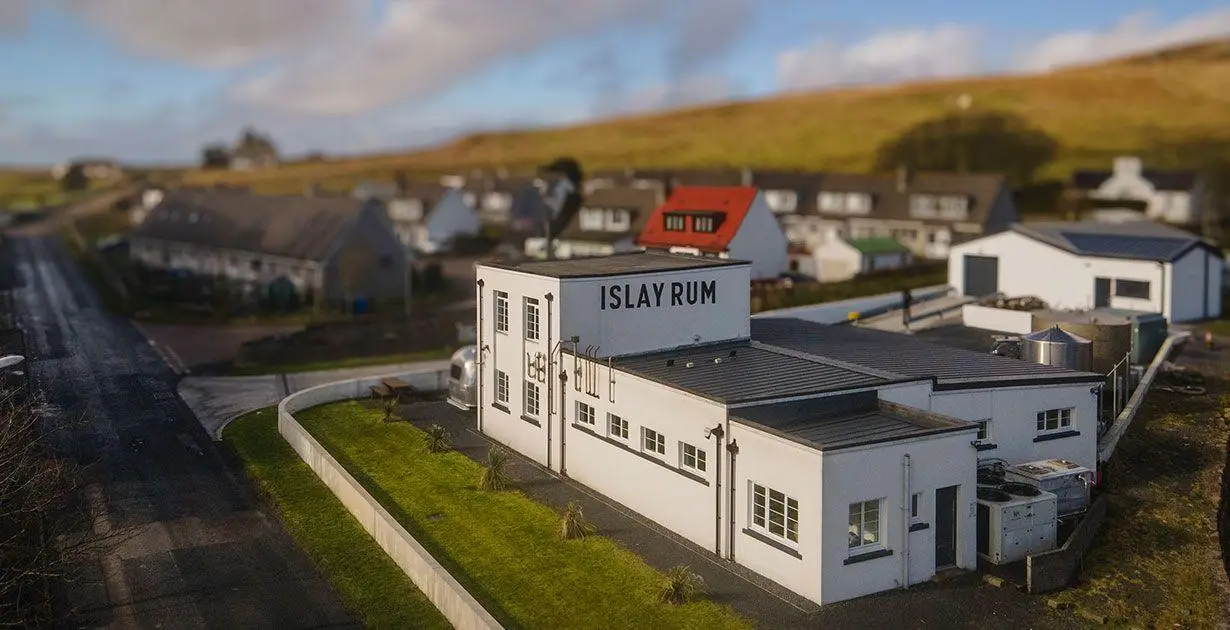
The family had long wanted a production site on Islay. In 2017, they purchased the former Hastie’s Lemonade Factory in Port Ellen, initially without a firm plan for the building. Then they met Ben.
“We were really taken by his passion for rum,” Andrew recalls. He also credits company secretary Caroline James, without whom, he says, “it simply wouldn’t have happened.”
Transforming the 1959 Art Deco factory into a distillery wasn’t straightforward. When I ask Ben about the challenges, his answer is “All of them.”
The building needed extensive repairs, but the team preserved its original footprint. In a rather fitting connection to the building’s history, the restoration was carried out by Scott Hastie, grandson of the factory’s original founders. Today, the distillery runs on 100% renewable electricity.
What The Islay Rum Company Does Differently
The first thing that strikes me about Islay Rum’s production process is the length of fermentation.
Starting with molasses, a byproduct of sugar production, Ben typically ferments his wash for five to seven days. By comparison, an Islay whisky distillery might ferment for up to around 72 hours.
“The longer the fermentation, the more flavor you can impart in your wash and then subsequently your spirit,” he explains.
During summer, Ben conducts wild fermentations lasting around six weeks, using naturally occurring yeast and bacteria from the surrounding environment.
He’s looking for “not only alcohol production, but acid production.” These acids contribute to the formation of esters, which help create the rum’s tropical aromas of pear drops, banana, pineapple and guava.
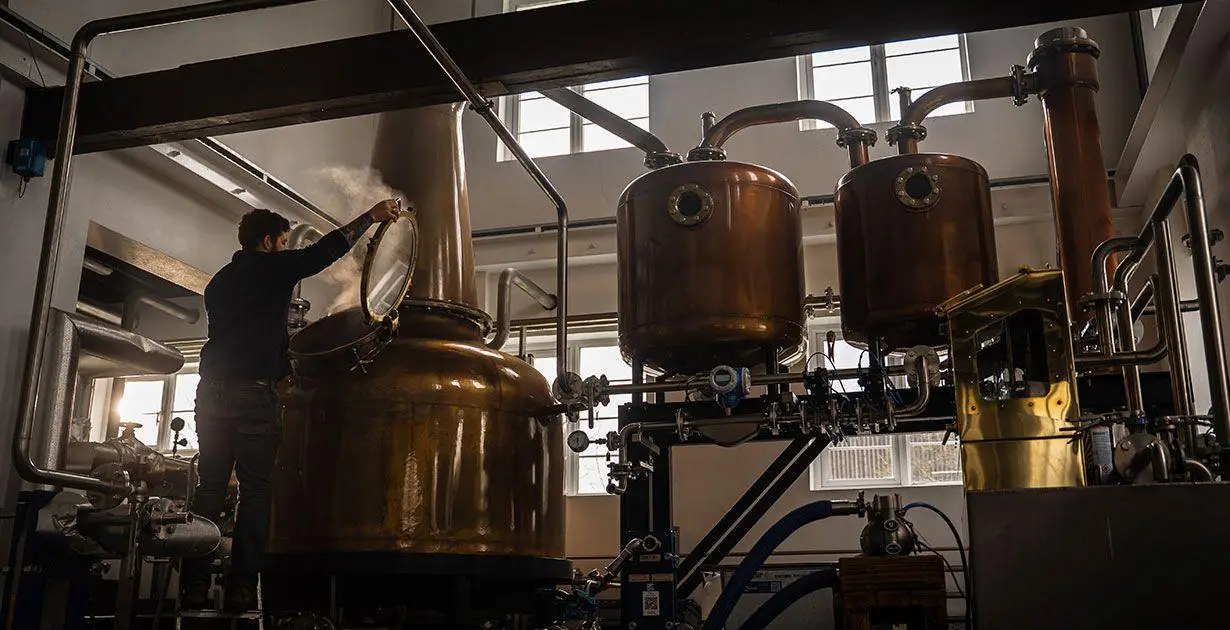
As for distillation, Islay Rum uses a copper pot still fitted with two retorts, vessels containing liquid from previous distillations through which the vapor passes before reaching the condenser.
Ben compares the retorts to plates in a column still. This arrangement allows him to produce the spirit he wants in a single run rather than distilling twice. The result is a full-bodied, oily rum with what Ben describes as “great body in the glass.”
There are familiar elements for a whisky drinker, including copper stills and a spirit safe, but the process produces something distinctly different from Islay’s single malts.
Island Climate, Island Casks
Rum is generally associated with warmer climates, so I was particularly interested in how Islay’s weather affects production and maturation.
For Ben, the seasons dictate much of the distilling calendar. Summer’s warmer temperatures encourage wild fermentation, while winter is better suited to more conventional production runs, most of which go into casks.
He compares this seasonal approach to historical whisky production, when distilleries often operated during winter while summer was devoted to growing barley. The differences become even more pronounced during maturation.
Andrew estimates that Scotch whisky typically loses around 3% to evaporation in its first year, followed by roughly 2% annually. In tropical climates, Ben explains, rum can lose 10 to 15%.
That faster evaporation concentrates the spirit, but it can also encourage excessive wood influence. Ben doesn’t believe one climate necessarily produces better rum than another. He’s more interested in understanding their differences.
Most of Islay Rum’s maturing stock goes into ex-Islay whisky casks, readily available through the Crook family’s bottling business. I naturally want to know how they prevent the smoke from dominating the rum.
“It is a balancing act,” Andrew admits, but he believes the casks complement the spirit, contributing “a nice smokiness and a kind of sea salty vanilla note to it.”
There’s also considerable uncertainty about how these casks will develop over time. With only around four years of production behind them, Andrew acknowledges there’s “no kind of rule book” for predicting what the rum might taste like after 10 or 15 years.
Although most stock currently matures on the Scottish mainland, a new warehouse in Port Ellen was completed this summer. Ben is particularly interested in comparing rum matured on Islay with rum aged on the mainland.
For a distillery still establishing its identity, those comparisons could prove fascinating.
The Islay Rum Company Range
The core range consists of three expressions.
Geal is the distillery’s unaged white rum and was its first release. Barrel Aged, matured in ex-Islay whisky casks, brings the island’s whisky heritage into the glass without overwhelming the character of the original spirit.
That balance appears to be working. Barrel Aged received Double Gold and 98 points at the 2026 San Francisco World Spirits Competition.
The third expression, Peat Spiced, takes a rather different approach. It’s made using orange, ginger and cacao nibs smoked over a peat fire.
I had a bottle waiting to try when we spoke, so I was keen to understand where the idea originated.
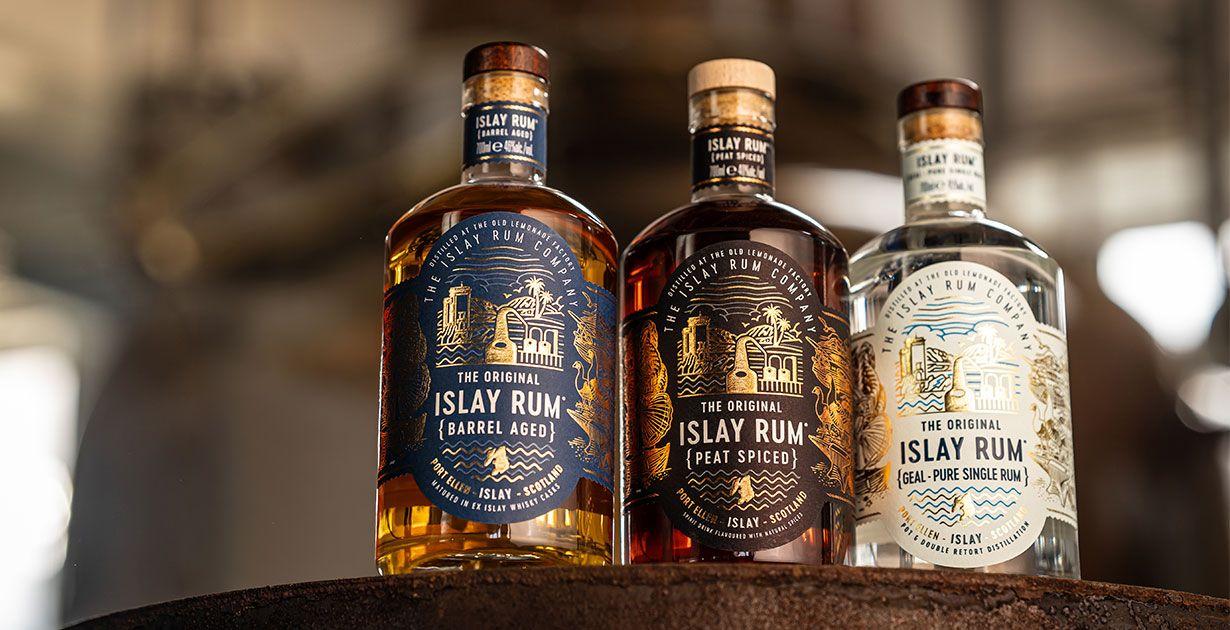
Ben tells me he had been experimenting with spiced rum long before joining the distillery, adding his own ingredients to shop-bought white rum. He particularly enjoyed warming winter flavors, which eventually inspired Peat Spiced.
Early reactions at shows were mixed, and he considered changing the recipe before deciding to trust his instincts. “It can be divisive; it can be a bit of a Marmite one. I would rather be that way than be boring and bland.”
The expression subsequently won Gold at the 2024 World Rum Awards, although Ben points out that the added ingredients mean it is technically classified as a spirit drink rather than rum.
Rum also gives Ben considerable freedom to experiment. Unlike Scotch whisky, which must mature in oak, rum can be matured in other types of wood.
“We can use any species of wood and we can finish it in any cask,” Ben explains. The distillery is already exploring these possibilities through limited-edition experimental bottlings and single cask releases.
Making the Case for Scottish Rum
Islay’s whisky reputation undoubtedly attracts attention, but does it make selling rum easier?
Andrew believes the island’s name opens doors, although convincing people that Islay can produce great rum remains a challenge.
“It’s still a challenge every day to try and convince people that Islay can produce rum, that Scotland can produce rum,” he admits. When he mentions Scottish rum while travelling for the family’s whisky business, people often “look at you kind of blankly.”
Ben encounters similar reactions from distillery visitors, who regularly ask why he’s making rum on Islay and whether he’s following Jamaican or Barbadian production traditions.
“We’re making an Islay rum, a Scottish rum,” he insists, adding that “in no way are we trying to replicate or copy anywhere else.”
For Ben, that’s precisely the point. He wants the island’s climate, environment and production methods to shape the spirit rather than conforming to expectations established elsewhere.
Recognition is beginning to follow. The distillery was named Scottish Rum Producer of the Year at the 2025 Scottish Rum Awards, while Ben was shortlisted for Distiller of the Year at The Spirits Business Awards 2026, with the ceremony set to take place on Thursday, 12 November.
Andrew sees these accolades as a “testament to the quality of liquid that Ben’s making.”
What Islay Rum Taught a Whisky Drinker
Ultimately, Islay Rum isn’t trying to replace the island’s whisky traditions. It’s using some of that experience to build something new.
I went into the interview knowing considerably more about whisky than rum, but came away with a new appreciation for just how much there is to explore. Islay Rum may draw on the island’s whisky-making heritage, but Ben and Andrew are determined to create something entirely its own.
As Ben puts it, “this is a hell of a category to explore.”