

Editor’s Note: This whiskey was provided to us as a review sample by the party behind it. This in no way, per our editorial policies, influenced the final outcome of this review. It should also be noted that by clicking the buy link in this review our site receives a small referral payment which helps to support, but not influence, our editorial and other costs.
J.W. McCulloch created Green River whiskey in 1885. For a time, it was a widely known, heavily produced, and internationally acclaimed brand. It came to an end when a combination of a warehouse fire and prohibition forced Green River to close in 1920. One hundred years later, the Green River Distilling Company announced a revival of the brand. Following this, in 2022, we saw the first new expression of Green River whiskey in over a century.
They’re distilling on the same site where McCulloch made the old Green River whiskey. Although they are reviving the brand, the distillery itself had already been in operation for years. The distillery has been active, in some form, for the better part of the last century. It’s been opened and closed, gone through renovations, and passed between different owners. It operated mostly as a contract distiller, and still does, but has produced a few of its own bottlings.
In 2014, the Terressentia Corporation purchased the distillery and made major renovations to bring it to its current capacity. At the time, however, it wasn’t operating as Green River Distillery but as O.Z.Tyler. They put out several expressions which used the “TerrePURE” process to rapidly age whiskey with ultrasonic waves and oxidation. These O.Z.Tyler bourbons only needed to age for a year and a day, but reviewed poorly.
In 2020, the O.Z.Tyler shifted gears from futuristic to historic. They rebranded as the Green River Distilling company, with the support of J.W. McCulloch’s great-grandson. Following this, in 2022 they released a new expression of Green River bourbon. This whiskey doesn’t use TerrePURE, just a traditional barrel aging. It’s a new approach that leans into the history of the site and the brand, down to the slogan “the Whiskey Without Regrets,” which is about as close as you can legally get to the original slogan “the Whiskey Without a Headache.” I can only wish.
Also, of more recent note, Green River was acquired last year by Bardstown Bourbon in a merger of historic and modern Kentucky roots.
The Green River Kentucky Straight Bourbon I’m reviewing here is their flagship offering. It’s made from Kentucky-grown corn, and has an above average presence of rye in its mash bill. Consequently, it should be a good introduction to the new Green River.
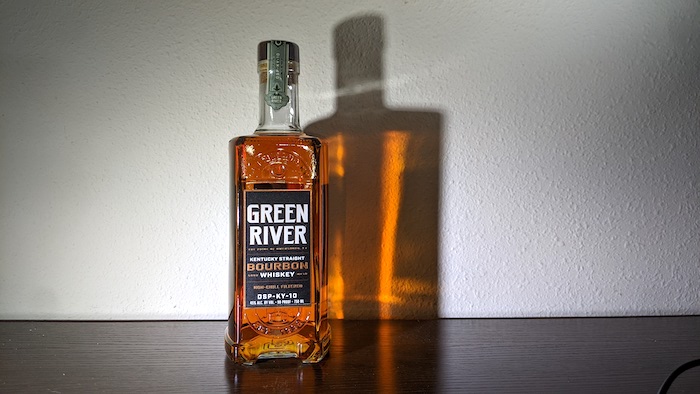
Tasting Notes: Green River Kentucky Straight Bourbon
Vital Stats: 45% ABV. Mash Bill: 70% corn, 21% winter rye, and 9% malted 2 and 6-row barley. 90 Proof. MSRP 37.99
 Trending Stories

Appearance: Burnished Copper
Nose: There’s an almost humid quality to the nose. It’s floral and sticky, with the feel of pollen. Underneath that, I can find hints of wood shavings and freshly ground coffee.
Palate: The flavor is light, smooth, and sweet with a strong taste of apple. Alongside the spiciness of the rye, it has the overall quality of an apple coffee cake. The apple profile is so clear that it almost feels like an apple liqueur, but it still has the body of a bourbon and no cloying sweetness. The grain is more present in the finish, which leaves a trail of apple flavored cereal and slightly astringent rye.

 Latest News