

Editor’s Note: As of press time for this review Diageo had just changed the name of this product to Blenders’ Mash.
Crown Royal, in case you weren’t aware, is a Canadian product created, sold, and marketed by beverage giant Diageo. I repeat: Canadian, not American. And you may also be keen to the fact that only booze producers here in the United States of America can use the word “bourbon” on approved alcohol labels to describe their US-sold product. So how did this Canadian whisky receive permission from the American government to label and sell their product in such a fashion down south?
As we reported earlier this year, the government basically screwed up. Diageo has one year to sell this product with said label in the U.S., and then they’ll be forced to rebrand. For now, though, we’ve got our first and possibly only “Canadian bourbon” to review here at the Whiskey Wash.
“Bourbon” or not, the verbiage on Crown’s label is still wonky. It appears to be influenced by the original Kentucky beverage, but how exactly? Like the more traditional, iconic iteration of Crown Royal, this begins life as a megablend of Canadian whiskies. The difference here is that an unknown portion of the spirit was aged in barrels that previously housed American bourbon. If you’re reading this article, you’re probably savvy enough not to be fooled in to thinking this is true bourbon, but can we set nomenclature aside for a second to see if this drink has any merit in addition to its historical status as the one that slipped through the cracks?
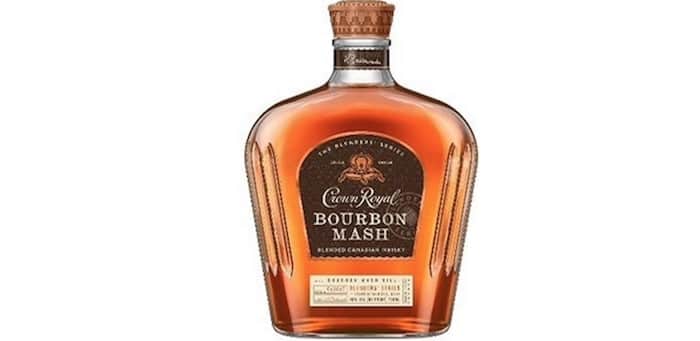
Tasting Notes: Crown Royal Bourbon Mash Whisky
Vital Stats: 80 proof. Canadian Whisky aged in a combination of new charred and ex-Bourbon barrels. $30/750ml.
Appearance: The whisky pours the familiar color of golden brown snickerdoodles, bouncing lively in the glass and leaving behind lovely legging. It possesses a solid level of clarity despite being a bit muddy or drab in its brightness.
Nose: The aroma is robust, although it does not come off as appealing. A very dry, unappetizing melange of wood shavings and paint thinner hits first, followed by some nuance of estery banana and classic circus peanuts. There is a hint of something promising, apricot, maybe, or guava. Whatever subtleties were to be imparted by the use of bourbon barrels are unfortunately absent in the aroma.
Palate: The first impression as it coats the palate is surprise, pleasantly, that this beverage is not as dominatingly sweet as the more accessible Crown Royal products. That’s about where the pleasantness ends, however, as the next perception is one of a flabby, thin body. The woodiness dominates the taste, evoking near-saline levels of umami and the dry, lingering character of peanut shell dust. Some vanilla appears at this stage, but reads in to a bigger bit of acrid, burnt caramel. There is a drinkability present, in part due to the thinness, once the palate acclimates to the sharper points here, which may be the high point of this drinking experience.
 Trending Stories



 Latest News