





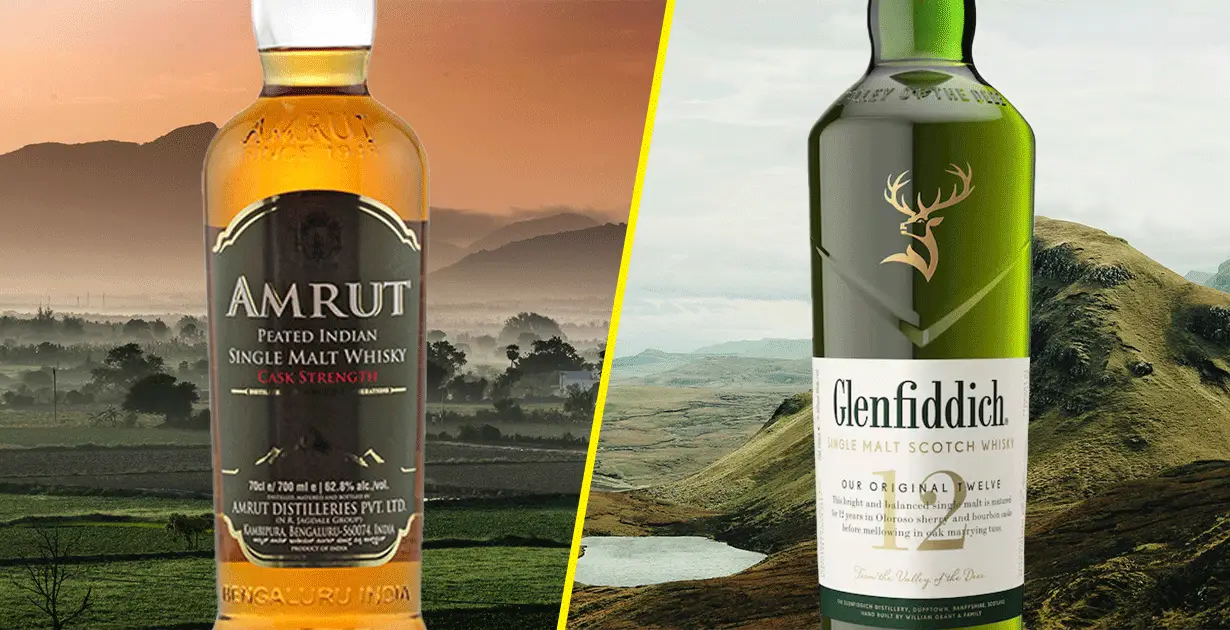
India drinks more whisky than any other country. In fact, it accounts for nearly half of all whisky consumed worldwide. But here’s the twist: more than 90% of what’s sold as “whisky” in India would not qualify as whisky in the U.S. or Europe.
This has everything to do with what it’s made from, how long it’s aged, and how it’s priced.
For Indian drinkers looking to trade up or understand what they’re really sipping, the distinctions matter. This article breaks down the five key differences between Scotch whisky and Indian whisky, and spotlights the new wave of Indian single malts that are changing the game.
Quick whisky question
Single malt is everywhere, but what does it mean? We want to know what the word “single” means to you. Three quick questions, under a minute.
1. Scotch Is Made From Grain; Most Indian Whisky Comes From Molasses
One of the biggest differences between Scotch whisky and most Indian whisky is the base ingredient.
By law, Scotch must be distilled from cereal grains, typically malted barley, wheat, or corn. The result is a spirit that retains the flavor of the grain and develops complexity over time in oak casks. The Scotch Whisky Association clearly defines whisky as a grain-based product aged at least three years in oak.
In contrast, the vast majority of Indian whisky (especially mass-market Indian Made Foreign Liquor (IMFL)) is produced using molasses, a byproduct of sugar refining. That means most Indian whiskies are technically rum-based neutral spirits with added flavor and color. Under U.S. and EU regulations, they cannot be sold as whisky abroad.
What Will Whisky Look Like in 2027? Voices from Whisky Live Paris
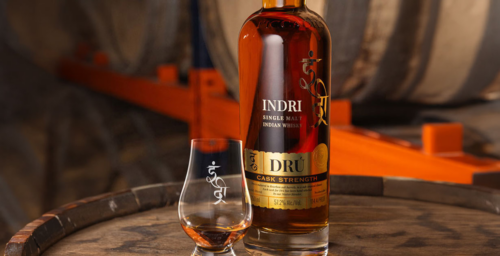
READ THE STORYHowever, a small but growing segment of Indian brands—like Amrut, Paul John, and Indri—is changing that. These single malts are made from 100% malted barley, just like Scotch, and meet all international definitions of whisky.
2. Scotch Requires 3 Years of Aging; Indian Law Has No Minimum
In Scotland, whisky is not legally whisky until it has matured in oak barrels for at least three years. This rule is set in UK law and enforced by the Scotch Whisky Association. Without that aging period, the spirit cannot be bottled or sold as Scotch.
India has no such legal minimum. According to the FSSAI’s standards, Indian whisky may be sold regardless of how long it’s aged, or whether it’s aged at all. Many IMFL brands include only a small amount of aged spirit, blended with younger molasses-based alcohol.
The exception is Indian single malts. Brands like Paul John and Rampur voluntarily adhere to a minimum 3-year maturation to comply with global labeling rules. This matters not just for exports, but for quality. Aging softens the spirit, deepens the flavor, and adds complexity, whether you’re in Glasgow or Goa.
3. India’s Climate Ages Whisky 3x ‘Faster’ Than Scotland
Okay, so the heading might be a little contrived. Indian whisky does not really “age faster”. When whisky experts say this, what they mean is that Indian whisky achieves a mature profile much quicker than Scotch.
In whisky, time behaves differently depending on geography. In Scotland’s cool, temperate climate, whisky matures slowly and gently. But in India, heat accelerates the process.
The average aging environment in India is hot and dry, which causes rapid interaction between spirit and wood. Industry experts often say that one year of aging in India is equivalent to three years in Scotland. That means a four-year-old Indian whisky can have the depth and barrel influence of a 12-year-old Scotch.
But there’s a trade-off. In India, whisky evaporates faster, a phenomenon known as the “angel’s share.” While Scotch casks lose about 2% of volume per year, Indian distilleries lose up to 12% annually.
This limits how long Indian whisky can age without excessive loss. It’s why you won’t often see Indian single malts with age statements above 7 or 8 years, even though they’re often just as rich.
4. Indian Whiskies Use Six-Row Barley; Scotch Uses Two-Row
Not all barley is the same, and the type of barley used in whisky making can make a huge difference to the final texture of the whisky.
Scotch distillers typically use two-row barley, known for its high starch content and low protein. It yields a cleaner fermentation and often a smoother, lighter texture.
In contrast, Indian single malts are usually made with six-row barley, which grows locally in Rajasthan and Punjab. It has more protein and husk, and less starch. This gives the whisky a heavier mouthfeel and a subtly spicier, oilier character.
It’s not a matter of quality, but of character. This grain difference is one reason Indian single malts taste distinct, even when they follow all the same production rules as Scotch.
5. Scotch Is More Expensive in India Due to 150% Import Duties
Scotch has long been seen as a premium product in India, but much of that perception is driven by price, not just quality.
Imported whisky in India is subject to customs duties of up to 150%, along with additional state taxes. This can inflate the shelf price of a mid-range Scotch to that of a luxury spirit. According to the Scotch Whisky Association, import tariffs are among the highest in the world.
By contrast, domestic whiskies (many of which are molasses-based) face far lower costs and duties. That cost gap gives them a home-field advantage.
As a result, many Indian drinkers assume Scotch is inherently superior. But price doesn’t always reflect production quality, especially now that Indian single malts are closing the gap.
The Rise of World-Class Indian Whisky
Despite all of these differences, the gap between Scotch and Indian whisky is narrowing fast.
Brands like Amrut, Paul John, Rampur, Indri, and Godawan are setting a new standard. They use 100% malted barley, age their spirits in oak for at least three years, and avoid molasses entirely. These distilleries follow the same production rules that define Scotch, and their whiskies are now earning awards on the global stage.
If you’re looking to trade up from mass-market blends, these Indian single malts are worth your attention. They offer quality, transparency, and flavor grounded in tradition.
 Latest On The Whiskey Wash