

Editor’s Note: This whisky was provided to us as a review sample by Diageo. This in no way, per our editorial policies, influenced the final outcome of this review. It should also be noted that by clicking the buy link towards the bottom of this review our site receives a small referral payment which helps to support, but not influence, our editorial and other costs.
With its blend dominated by whisky from Cardhu, the newest Jane Walker comes from a long line of powerful women. The press focuses around Emma Cumming, who sold the distillery to John Walker and Sons in 1893. The history, however, goes back to her mother-in-law and forbear, Helen.
Cardhu is situated on Mannoch Hill, a perfect place to watch over the valley of the River Spey. Many of the distilleries in the Highlands were unlicensed at the time. From her vantage, Helen could see the excise men coming. Legend holds she would dust herself with flour, run out to greet them saying she was baking bread – that was the yeasty smell, and offer them tea. While they were distracted, she would raise a flag to warn the other distilling families to conceal their operations.
Elizabeth herself was no slouch. In 1872, her husband died, and though she was the mother of two and had a third on the way, she made an unexpected decision for a woman of her era. She moved, expanded and modernized Cardhu, selling the old digs to William Grant (who would start an obscure brand called Glenfiddich). She increased the output by three fold. By the time she did sell to John Walker and Sons, the facility went for a handsome sum that secured the family for decades to come.
Thanks to their protection, whisky from Cardhu still makes up a large stake in Johnnie Walker blends. Cardhu whiskies are smooth, sweet, and clean in the Speyside style. The is the second iteration of this label, with the first iteration of Jane being a rebranded Johnnie Black Label. This time, she gets her own blend of just malts, and a female blender to put it all together.
Master Blender Dr. Emma Walker crafted this limited-edition. She had access to 10 million casks when deciding! Walker was a chemist before coming to blending, and used those skills to research and select what would be in the bottle.
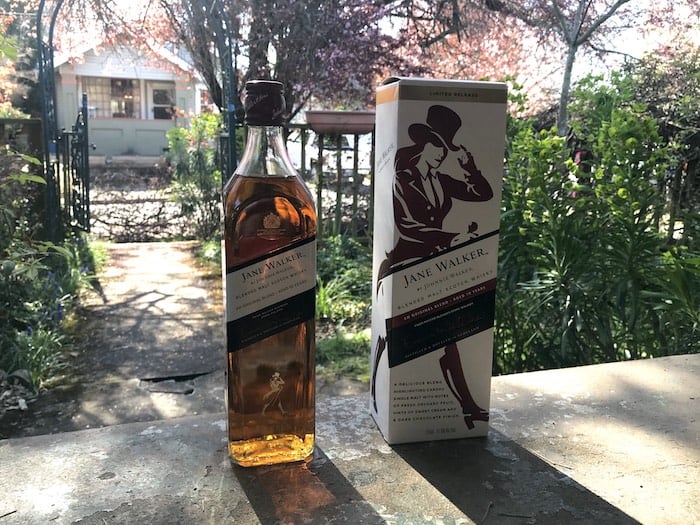
Tasting Notes: Jane Walker by Johnnie Walker (2020)
Vital Stats: Jane Walker is 83.8 proof, made from 100% malted barley and aged 10 years. Find a 750mL for $38.
Appearance: This spirit comes in the typical square Walker bottle tucked inside a white box emblazoned with the Striding Woman. The liquid is medium honey with a glint of copper and very clear.
 Trending Stories

Nose: Delicate on the nose, this whisky is subtle – clean sea air, no damp seaweed here. Floral notes come through, and a bit of stone fruit roundness. Toffee sweetness blossoms as it rests in the glass.
Palate: What’s hinted at in the nose comes true on the palate – a gentle whisky, apricot and tea cakes with a wisp of smoke. A slight herbal bitterness hits on the back palate.

 Latest News