




For years, scotch drinkers have clung to a simple rule: single malts are better. They’re seen as more complex, more refined, and more worthy of your top shelf. Blends? They’re often treated as the easy-drinking understudies. Cheaper. Simpler. Forgettable.
But what if that hierarchy isn’t grounded in reality? What if much of what we think we know about scotch is shaped more by branding than by the whisky itself?
Taste tests, chemical analysis, expert insight, and market trends are all starting to tell a different story. The divide between single malt and blend may be far less rigid than tradition suggests.
What Will Whisky Look Like in 2027? Voices from Whisky Live Paris
READ THE STORYIt’s time to pull apart the single malt myth, and maybe change the way we think about scotch for good.
Single Malts vs. Blends: Debunking the Flawed Test
Scroll through YouTube or whisky forums and you’ll find no shortage of “single malt vs. blend” blind tastings. They often end the same way: the single malt is praised for its depth, and the blend is dismissed as thin or forgettable. It seems like an open-and-shut case.
But most of these comparisons fall apart under scrutiny.
 Trending Content



They rarely control for basic variables. A cask-strength Islay malt is pitted against a 40% supermarket blend. One might be 15 years old, the other 3. Differences in smoke, age, oak, and strength almost always guarantee a lopsided result.
In a controlled setting, however, the question gets far more interesting. Imagine two whiskies: same age, same ABV, similar cask profile. One is a single malt from a single distillery. The other is a carefully made blend of grain and malt whiskies. Could you tell them apart without seeing the label?
Scotch Under the Microscope
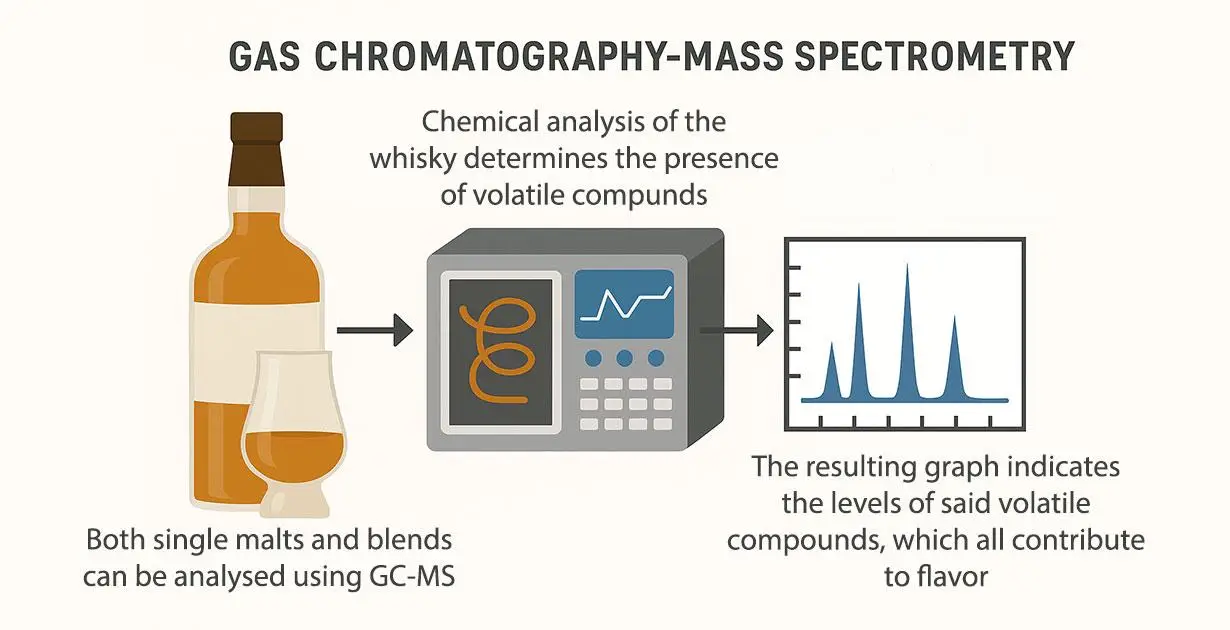
A whisky’s flavor isn’t just a matter of opinion. It can be measured. In labs across Scotland and beyond, scientists use tools like gas chromatography–mass spectrometry (GC–MS) to break down the exact compounds in a dram. These chemical fingerprints reveal the real architecture behind aroma and taste.
Each whisky contains hundreds of volatile compounds—including esters, phenols, aldehydes, and lactones. These shape everything from fruity top notes to smoky finishes, and GC–MS can detect them all. What this analysis has shown is simple: both single malts and blends are chemically complex. One isn’t inherently richer than the other.
It’s tempting to assume that single malts, made from 100% malted barley in pot stills, must be more layered. They do often carry a strong distillery character; bold esters from fermentation, heavier oils from the stills, or signature notes from cask aging. But this doesn’t automatically mean more complexity.
Blends, especially premium ones, take a different approach. They combine single malts and lighter grain whiskies, often from multiple distilleries. This reframes the character of the blend. A blend might offer a wider spectrum of aromas and flavors, arranged with precision to create harmony. In many cases, this results in just as many flavor compounds as a single malt, sometimes more.
Grain whisky plays a key role here. It’s often dismissed as filler, but that’s a misunderstanding. Grain brings texture, sweetness, and structure.
Chemical complexity, then, is not a question of malt versus blend. It’s a question of balance, intent, and design. Analytical tools can spot differences. But the real surprise is that those differences don’t always show up in the glass.
The science is clear. Blended scotch is no less complex. It’s just complex in a different way.
How to Taste the Difference (When the Fight Is Fair)
Blind tasting two whiskies, one a single malt, the other a well-made blend, can be humbling. When the cask type, age, and ABV are matched, even seasoned drinkers struggle to separate them.
In fact, a study published in the journal Flavour put this to the test. Researchers asked both casual drinkers and trained panelists to sort a range of whiskies by similarity. No obvious pattern emerged between single malts and blends. The paper concluded that there was “no broad perceptually salient difference” between them when tasted blind at similar strengths and profiles.
This suggests that many of the distinctions we claim to taste are shaped less by what’s in the glass and more by what we expect to find.
Still, there are clues if you know what to look for.
Single malts often carry a distinct distillery character. Think of them as soloists. You might get a burst of orchard fruit from a Speyside malt or coastal brine from an Island distillery. These whiskies can feel focused, even spiky. One flavor or aroma usually stands out, a signature that repeats across the range.
Blended scotch plays a different tune. It’s designed more like an orchestra. Multiple malts are layered over a base of grain whisky, which acts as the canvas. The result tends to be smooth, rounded, and broad. Flavors may unfold more gradually.

Texture offers another clue. Blends often feel lighter on the tongue. That’s the grain whisky at work, lending sweetness and softness. A single malt might feel oilier or more intense, especially if it’s non-chill filtered or bottled at higher proof.
But these are patterns, not rules.
In practice, plenty of single malts are gentle, and plenty of blends carry weight and power. Many blended malts, whiskies made only from single malts, blur the line even further. So the only real test is this: if the labels were gone, would you still reach for the same dram?
That question is starting to reshape the whisky world itself. As more drinkers let go of old assumptions, a new tier of blends is rising to meet them, crafted to stand shoulder to shoulder with the best single malts.
The Rise of the Super-Blend
For years, “blend” meant basic. Dependable, maybe, but never collectible. That’s no longer true.
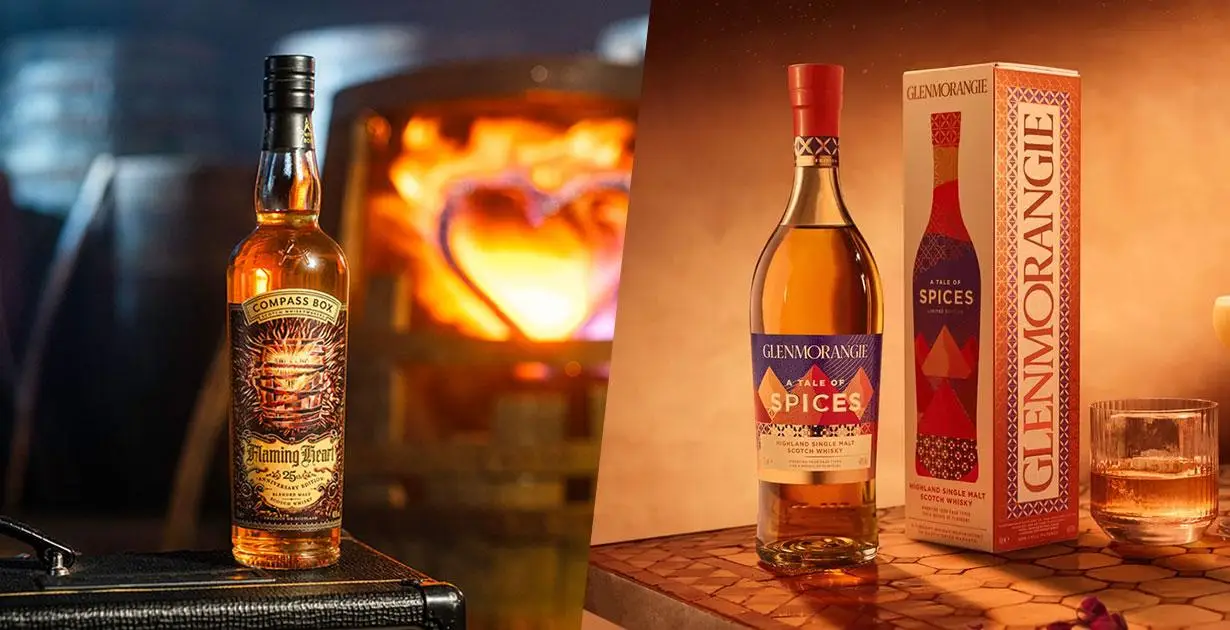
A new generation of whiskymakers is proving that blending is not the opposite of quality, it’s a creative craft. At the forefront is Compass Box, founded by former marketing director-turned-blender John Glaser. Glaser has since left Compass Box, but his founding aim was clear: to show that blends can be every bit as complex and compelling as single malts.

Releases like The Spice Tree and Hedonism have done exactly that. The former, a spiced, oak-rich blended malt, challenged traditional production rules. The latter is made entirely from grain whiskies and is anything but neutral. These are blends with depth, detail, and price tags to match.
Even industry giants are rewriting the script. Johnnie Walker Blue Label has long held luxury status, but limited releases like Ghost and Rare have raised the bar. These blends feature rare components from closed distilleries like Port Dundas and Brora, often bottled at higher strength and aimed squarely at collectors.
Elsewhere, Japanese blends like Hibiki have shown global drinkers that balance and nuance can rival boldness. And they sell accordingly.
In short, the old blend-versus-malt divide is falling apart. Not because blends are catching up, but because they’ve quietly been world-class all along.
Tasting the Truth
Can some people tell the difference between a single malt and a blend when the conditions are fair? Yes. A few seasoned drinkers, sensory analysts, and blenders might be able to pick up subtle cues. But for the vast majority of whisky lovers—even many enthusiasts—the line between the two isn’t so easy to spot.
And honestly, it doesn’t matter.
What matters is what’s in the glass. There are blends that offer as much depth, nuance, and evolution as any single malt. There are single malts that prioritize smoothness and balance over intensity or edge. Complexity is not the sole property of one category. Nor is quality.
So drop the bias. Explore widely. If a whisky moves you, that’s enough. Whether it came from one distillery or five, whether it says “blend” or “malt” on the label—if you enjoy it, it counts.