




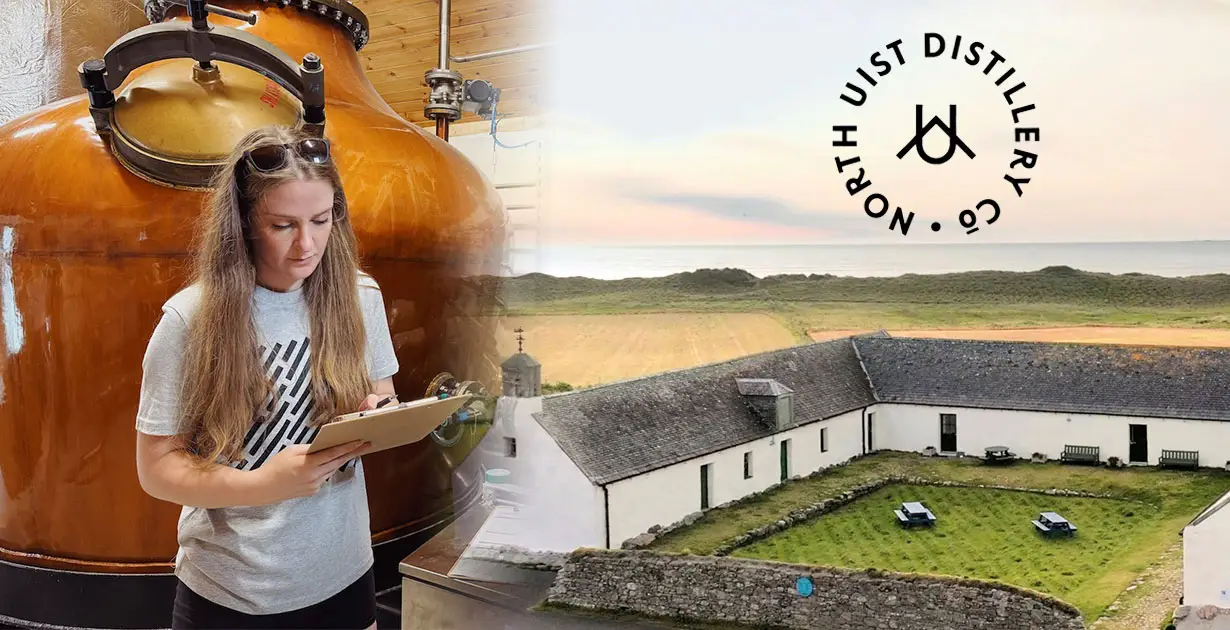
North Uist Distillery has been filling casks since Hogmanay 2024, which means there is nothing yet to buy, taste, or review. What there is instead is a set of decisions being made now that will determine what the whisky tastes like when it eventually appears, and a distiller who is happy to talk through all of them.
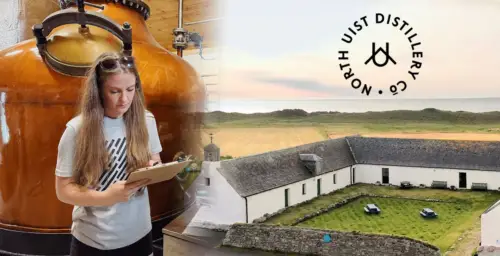
The production scale is about as small as a Scotch distillery gets, producing roughly 400 casks a year. Kate and Jonny MacDonald founded the company in 2017 and converted Nunton Steadings, an 18th-century farm building in Benbecula, into the distillery it is now.
Olivia Gibson joined as distiller in April 2025, having come from Arran. When I spoke to her, she had just finished a shift and was still catching her breath from it, which turned out to be relevant to almost everything she went on to describe.
What Will Whisky Look Like in 2027? Voices from Whisky Live Paris
READ THE STORYUist: The Bread Basket of the Hebrides
North Uist Distillery is named for the Hebridean island of North Uist, but Nunton Steadings sits on Benbecula, the island immediately south. Kate and Jonny are both from North Uist, and the two islands are joined by a causeway. Despite this slight geographical divide, North Uist Distillery is nothing if not a representation of its namesake island, right down to the grain that is used.
Uist is unusual among the Outer Hebrides, and therefore great for making whisky, because of its fertile soil. “Uist is known as the bread basket in the Hebrides,” she says. “If you go to like Lewis and Harris, they don’t have a lot of ground that they can grow arable crops on. It’s very heathery, whereas Uist, it’s got nice sandy soil and it’s really fertile.” According to Olivia, the Gaelic nickname for North Uist, Tìr an Eòrna, means land of the barley.
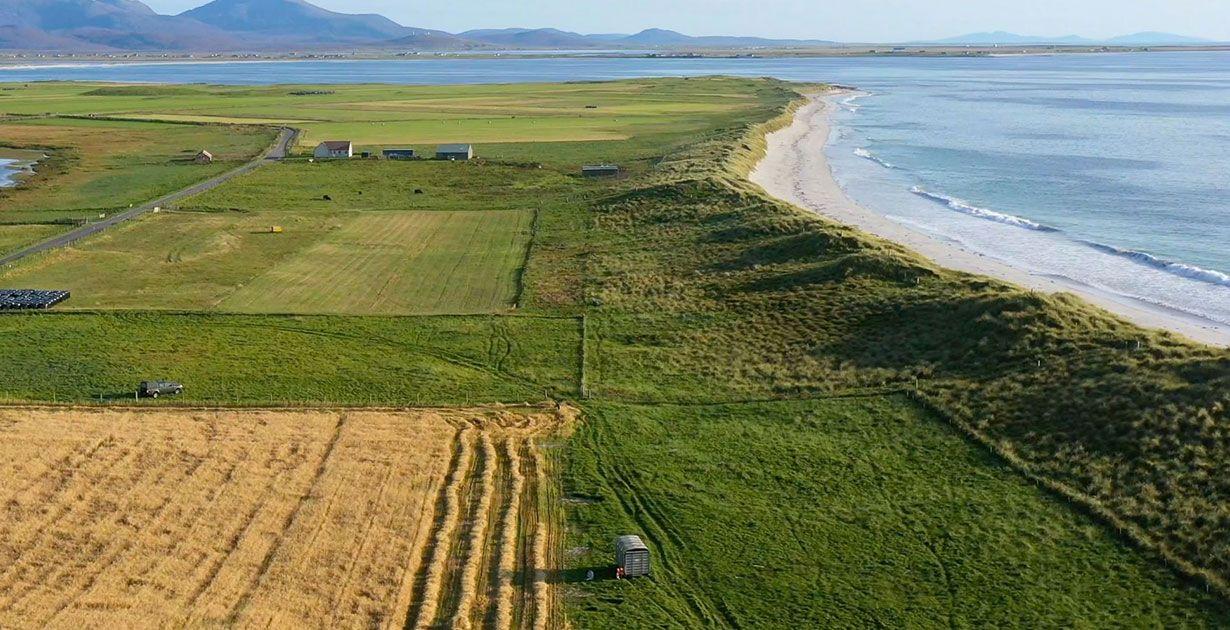
Bere barley is the grain at the center of this, a variety grown on the islands for centuries. “It’s the only barley that’s ever been consistently grown here,” Olivia says, and the reasons are practical. Bere has a shorter growing season than modern varieties, which counts for a lot in a place with a short summer, and it tolerates acidic, low-nutrient soil.
 Trending Content





There is an ethic attached to the land as well as a method for farming it. Crofters here, Olivia says, “have grown up being taught that if you take from the land, you have to give something back to it,” and when a field is being prepared for ploughing or seeding, bird nests are lifted carefully and put back once the work is done.
The decision to build a whisky around this grain came from two directions. Kate and Jonny wanted a whisky belonging specifically to Uist, and distillery manager Jacob arrived with experience growing, malting, brewing, and distilling heritage varieties, most of it built over years at Dornoch Distillery.
Building Flavor in the New Make
Bere yields less than modern barley, and North Uist accepts that trade because of what it gives back. It carries a higher protein-to-carbohydrate ratio, which produces a different set of congeners through mashing, fermentation, and distillation. In Olivia’s tasting, the resulting new make is full of “berries and dark fruits.” She describes a “velvety mouth feel, oily, robust spirit” carrying through every cask sample she has drawn so far.
Bere goes into every mash, and the ambition is to get to a full bere mash bill eventually, alongside other distinct whisky styles built around carefully constructed mash bills. Other heritage varieties include Maris Otter and Chevallier, with Golden Promise being grown for the distillery on a farm in Sutherland.
The equipment is modest. Five wooden washbacks are filled to 2,850 liters, running one washback to one wash still, and the spirit still holds 2,000 liters but is usually charged with 1,600. Wooden vessels are harder to clean than stainless steel and they hold a resident microflora that stainless does not, which is the whole point for a distillery interested in what its own site contributes.
Wood, and Why She Wants Second Fills
The cask inventory is broader than the production volume would suggest. Most of what has been filled so far is first-fill bourbon, with a small number of second-fill barrels alongside it. Last year’s fills worked out at roughly 90% bourbon and 10% sherry, using hogsheads from Juan Piñero, and the plan for this year is to push the sherry proportion higher. Beyond that there are quarter casks, virgin oak in French, American, and European varieties, and a set of hybrid octaves.
Second fill casks are a routine part of Scotch production, used across the industry to keep wood influence in proportion and to let spirit character sit further forward. What was less familiar was hearing a distiller talk about them with genuine enthusiasm rather than as a matter of inventory management.
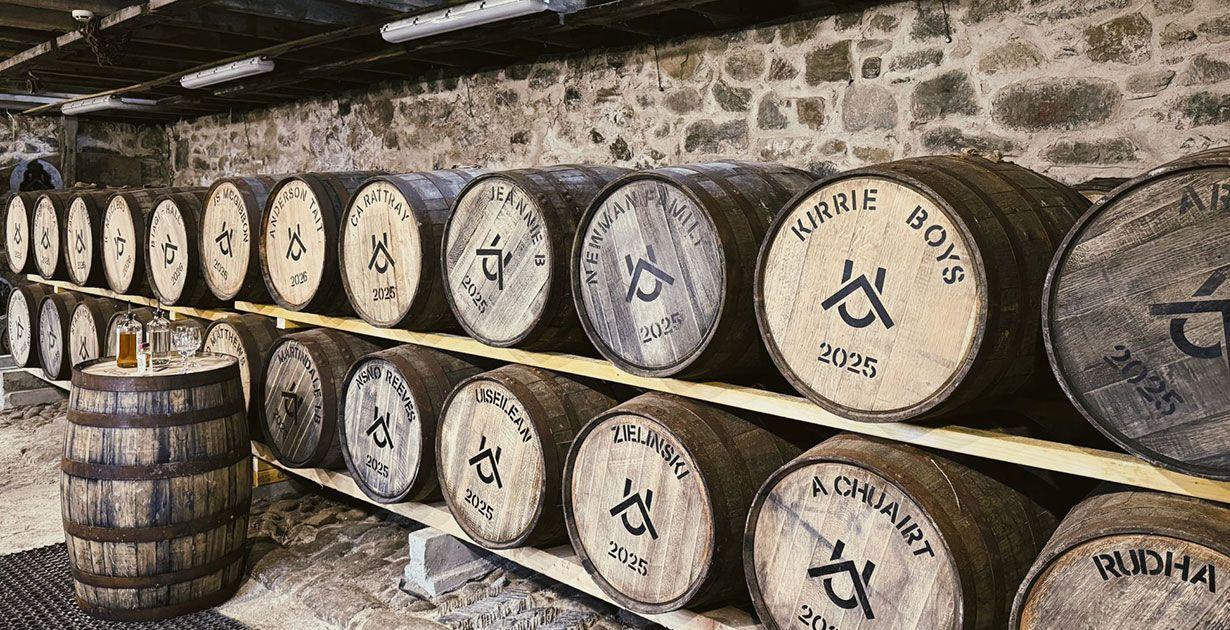
“We’re really keen to have a bit more second-fill wood,” Olivia says, “because we work really hard on our spirit. So I’d like some of the spirit character to shine through.” She is clear that the first fill bourbon is working well, and the cask samples she draws carry a strong sweetness from it. The interest is in seeing what a quieter cask does with a spirit built to be robust in the first place.
She is aware this is not how second fills usually get discussed. “When you think broadly, people are like, ah, it’s just second fills,” she says, describing how they often end up blended away into something else. Filling more of them this year also means waiting longer for those casks to be ready, which is a cost the distillery seems content to take on.
The Peat Experiment
Peated malt was always part of the plan, though the level was not settled in advance. The distillery has spent around three months on a peated run and treated it largely as a research exercise. The aim is to have a small peated production over 1 to 2 months of the year.
Most of the work in this experiement went into cut points, which Olivia spent weeks moving around, including a deep cut at 58%. At 25 ppm, cutting at around 61%, they found what they were after: a good oily texture, and a note she describes as burnt butter.
There is a local complication, which is that peated whisky is a hard sell on the islands. “If you speak to any Hebridean, they are not keen on peated whisky,” Olivia says, her theory being that peat is simply what many people here burn at home.
The stills moved to 100% peated malt shortly before we spoke. The harder test comes in a few weeks, when they switch back to unpeated production, which is usually where the difficulties show up.
Small by Design and Supported by Community
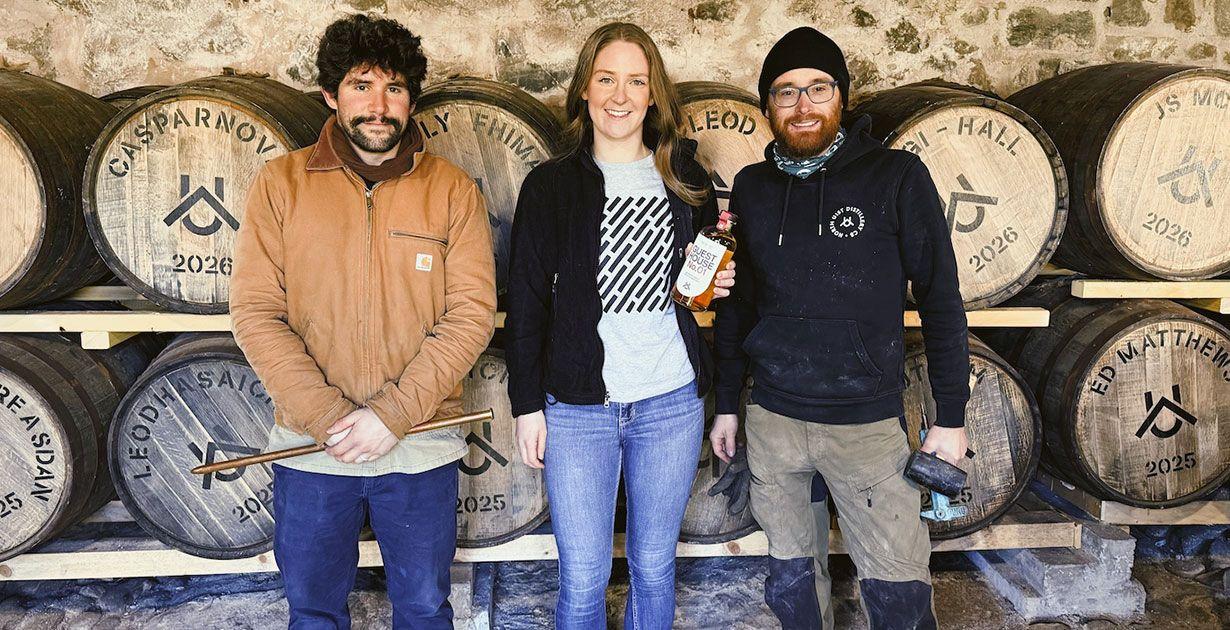
The 300-year-old steading sets limits on what North Uist can produce, and the team has worked within those limits rather than against them. “The stills poke out of the building,” Olivia says, which gives some sense of how tight the production hall is.
The constraint is real, but it has not been the main brake on output. There is no target volume set by ownership. “Kate and Jonny didn’t give us a target LPA,” Olivia says, “and if we don’t meet that, you know, there’ll be reasons for it.” Her summary of the brief is to produce a very good spirit rather than a large quantity of it.
A good deal of the practical support around the distillery comes from the township. Draff goes to local crofters, who collect it by tractor, and the volume is small enough to fit into a single commercial fish tub.
When a delivery of third-party casks arrived at the Lochcarnan warehouse with nothing on site to unload it, Olivia and Jacob called a local farmer who came down with forks on his tractor. A retired builder across the road lends them tools often enough that Olivia describes him as an unofficial part-time handyman.
The next step is a malting shed, due to become operational at the start of next year. At present, the barley goes to the mainland for malting and returns in 25kg sacks, twenty of which Olivia loads into the hopper each day. The obstacle is not the malting, but the drying that comes before it, since the islands have no commercial-scale grain dryer, and how that gets solved is still an open question.
What the First North Uist Release Might Look Like
Everything North Uist has filled is maturing on the islands. The warehouse wing at Nunton, once the stables, still has its original cobbles and holds the founder casks along with a small number of the distillery’s own. The rest sit at Lochcarnan in South Uist, roughly 200 casks at present.
The working expectation is a release at around three and a half years, with the caveat doing real work in that sentence. “We’re hoping to bring it out at three and a half year old,” Olivia says, “you know, if it’s ready.” Nothing about the timing is fixed. Given the volumes involved, any first release will be limited, and she has not yet worked out how many casks it would draw on.
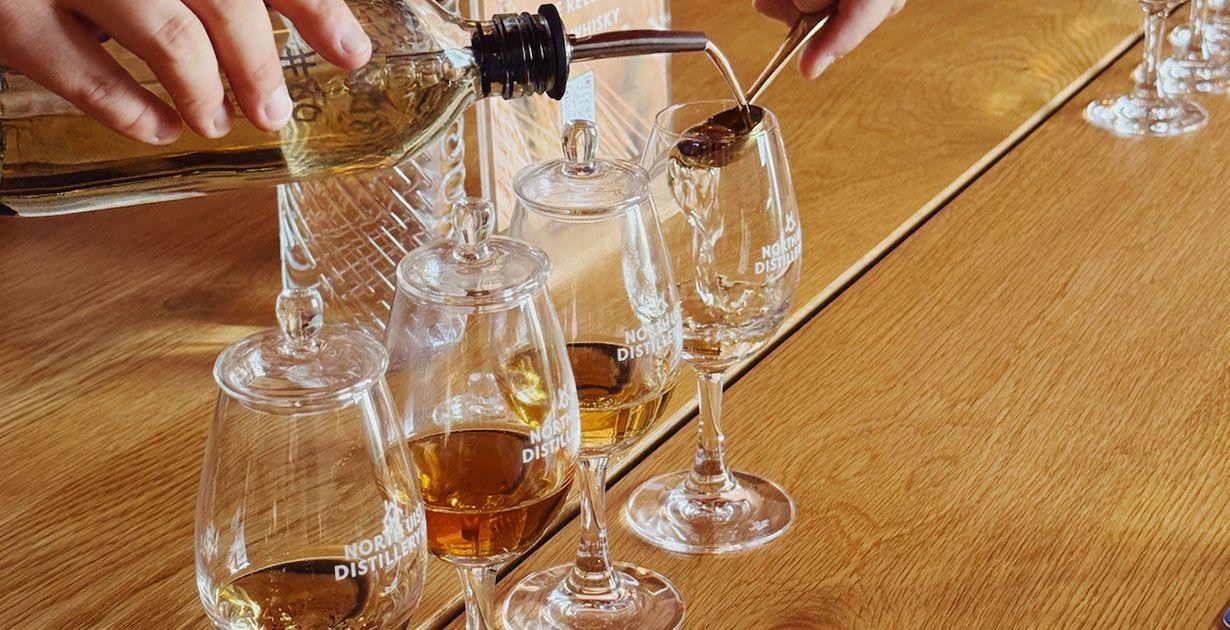
Members of the Founders Club are guaranteed a bottle of a pre-release before the official launch. An age statement seems likely at some point, though not necessarily on the first bottling, and her instinct is that it will be bourbon matured.
The distillery has already bottled whisky it bought in rather than distilled, under the Guest House name, and the second of those gives some sense of how the team makes decisions. It was a single cask Dailuaine that came in as a heavy leaker with 70 to 75 liters left and a lot of headspace above it, which meant a fair amount of oxidation. They left it at Lochcarnan and kept returning to it.
“We tried it, we kept trying it,” Olivia says, “and after maturing for about 6 months in Lochcarnan, and we were like, let’s bottle this, it’s good to go.” It has since sold out, as did the first cask offer, which went in a little over a minute.
A Uniquely Uist Distillery
North Uist is in an unusual position for a distillery, in that almost everything about it is still being settled. The mash bill is heading toward more bere as the supply chain allows. The peating level has been arrived at but not yet tested through a full changeover. The malting shed is not built, and the grain drying problem behind it is unsolved. Nobody outside the Founders Club will taste the whisky for some time yet.
What comes across in talking to Olivia is that none of this is being treated as a holding pattern. The bell at Nunton Steadings, which has been silent since it was rung at the turn of the millennium, will be rung again when the first whisky is bottled. There is a while to wait before anyone finds out what it was ringing for, but I, for one, cannot wait to see what North Uist Distillery produces.