

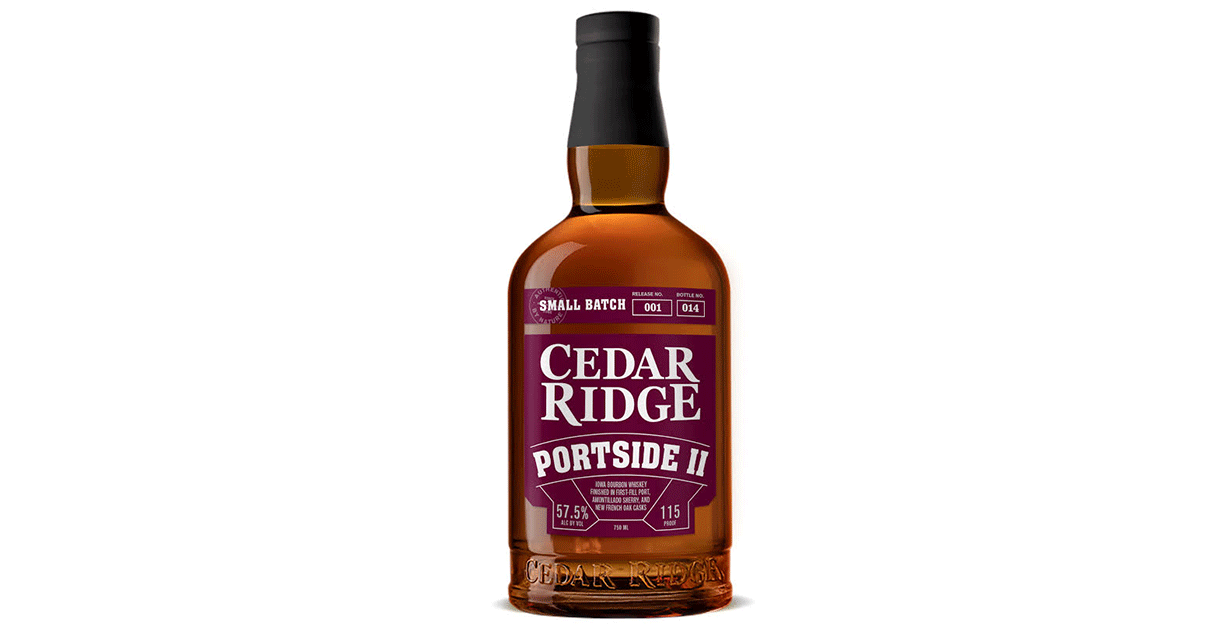
Cedar Ridge Distillery has released Portside II, a limited-edition small-batch Iowa bourbon finished in three separate cask types. The whiskey launches today at a suggested retail price of $59.99 and builds on the Swisher, Iowa-based distillery’s 2023 QuintEssential Special Release of the same name.
Portside II starts with Cedar Ridge’s flagship Iowa bourbon, which is aged in New American Oak. The liquid is then finished in new French oak, First-Fill amontillado sherry, and first-fill port casks.
According to the brand, the port casks are sourced from three locations: Portugal, California, and the distillery’s own Estate.
The bourbon is bottled at 115 proof (57.5% ABV) and comes in a 750ml format. Its mashbill comprises 74% corn, 14% rye, and 12% malted barley.
Master distiller Murphy Quint explained the thinking behind the new expression. “The original Portside is one of my all-time favorite blends, and Portside II is our chance to push that idea further,” he said.
Quint added that the finish marks a departure from the original. “Up front, you’ll find the same heavy fig, raisin, and black cherry that defined the original release, but on the finish the bourbon takes over and pulls it in a direction of its own.”
The master distiller described the project as a personal milestone. “It’s the first time I’ve moved a concept from one category of whiskey to another, and I really enjoyed the challenge,” he noted.
Cask finishing remains central to the distillery’s approach. “Experimenting with cask finishing allows us to explore the full range of flavor different casks bring to our whiskey,” Quint said.
Portside II will reach retailers across seven states: Iowa, Illinois, Minnesota, Indiana, South Dakota, California, and Florida. The bourbon will also be available direct-to-consumer in 45 states.
Founded in 2005, Cedar Ridge is Iowa’s oldest distillery and bills itself as the state’s first legal distillery since Prohibition. The producer has built its reputation on grain-to-glass whiskey made from locally grown corn, positioning itself among a growing cohort of Midwestern craft distillers challenging Kentucky’s traditional dominance in the American whiskey category.