



What is Scotch whisky? It might seem like a simple question, but legally speaking, what makes Scotch different from every other whisky in the world?
There are a few terms we need to break down, because Scotch whisky is not just about single malts and blends. Once you understand the main categories, you get a much clearer picture of the different styles of whisky that can be made in Scotland.
Malt & Grain Scotch Whisky
The two core types of whisky produced in Scotland are single malt and single grain, and these are the components that eventually make up blended Scotch.
What Will Whisky Look Like in 2027? Voices from Whisky Live Paris
READ THE STORYA blended whisky is not created at the distillation stage. It is made after those two separate whisky types have been distilled, matured, and produced according to their own distinct rules. Only then can a blended Scotch technically be created.
There was once a rather unusual practice where malt and grain new make spirit could be blended together before being matured in a cask. This was sometimes referred to as a cask-aged blend. That process is no longer permitted under Scotch whisky regulations.
Single Malt Scotch Whisky Rules
To make a single malt Scotch whisky, you have to follow a specific set of rules. It must be made from 100% malted barley, mixed only with yeast and water, and mashed, fermented, and distilled at a single distillery.
 Trending Content



The distillation must take place in pot stills, using a batch process. The spirit must then be matured in oak casks not exceeding 700 litres for a minimum of three years.
It must also be matured and bottled in Scotland. If it is rebottled or relabelled outside Scotland, it can no longer be called single malt Scotch whisky. Caramel colouring is permitted, but additional flavourings or alcohols are not. It must be bottled at no less than 40% ABV, or 80 proof, and water can be added to reduce the spirit to bottling strength.
Lots of rules to follow, then. But if you do follow them, you have created what many people consider to be one of the most sought-after spirit styles in the world.
Single Grain Scotch Whisky Rules
Single grain Scotch whisky is not a million miles away from single malt in terms of regulation. The key difference is the production method.
This is where most of the confusion lies. Single grain Scotch whisky does not need to be made from just one type of grain. It can be made from malted barley with or without other grains, such as corn, wheat, maize, or rye. The word ‘single’ here, much like with single malt Scotch, means the whisky was made at a single distillery.
In terms of distillation, instead of pot stills, it is usually distilled through a continuous still, such as a column or Coffey still.
Once distilled, the whisky must be matured in oak casks not exceeding 700 litres for a minimum of three years. It must also be bottled in Scotland to be called single grain Scotch whisky.
As with single malt, caramel colouring is permitted, but additional flavourings or alcohols are not. It must be bottled at no less than 40% ABV, and water can be added for dilution.
The biggest differences, then, are the still type and the grain recipe. Continuous stills can distil to a much higher ABV, which can strip out more character from the final spirit, depending on how the distillation is managed. The use of other grains also changes the flavour profile.
Overall, single grain whisky tends to be lighter, softer, and often sweeter than single malt.
Blended Scotch Rules
As we touched on above, to make blended Scotch whisky, you need both single malt and single grain. Technically, that means one or more single malt Scotch whiskies and one or more single grain Scotch whiskies.
Once those separately matured whiskies are combined, you have a blended Scotch whisky. Most of the wider Scotch regulations still apply. It must be bottled in Scotland, it can only have caramel colouring or water added to it, and it must not be bottled below 40% ABV.
Creating blended Scotch is arguably one of the most interesting things you can do with whisky. You are taking single malts and single grains with distinct flavour profiles, then combining them in a way that brings out the best parts of each component.
It is a bit like being a band manager. You need the best singer, the best guitarist, the best bass player, and the best drummer. Once you have found your key ingredients, you can bring them together in whatever way makes the whole thing work best.
Blends do tend to be cheaper, because grain whisky is generally less expensive to produce than malt whisky. Many blends, though not all, contain a high proportion of grain whisky. Because grain whisky is made through continuous distillation, it can be produced in larger volumes at a lower cost. Single malt, by contrast, is made through batch distillation, which is naturally slower and more expensive.
Blended Malt Scotch Whisky Rules
At one point, these were often called “pure malts,” a term that is still used in Japan. The name later changed to “vatted malts,” before finally becoming “blended malts” in 2009.
A blended malt follows the same broader rules around colouring, bottling strength, and being bottled in Scotland. The key point is that it is made exclusively from single malt Scotch whiskies. There is no grain whisky involved.
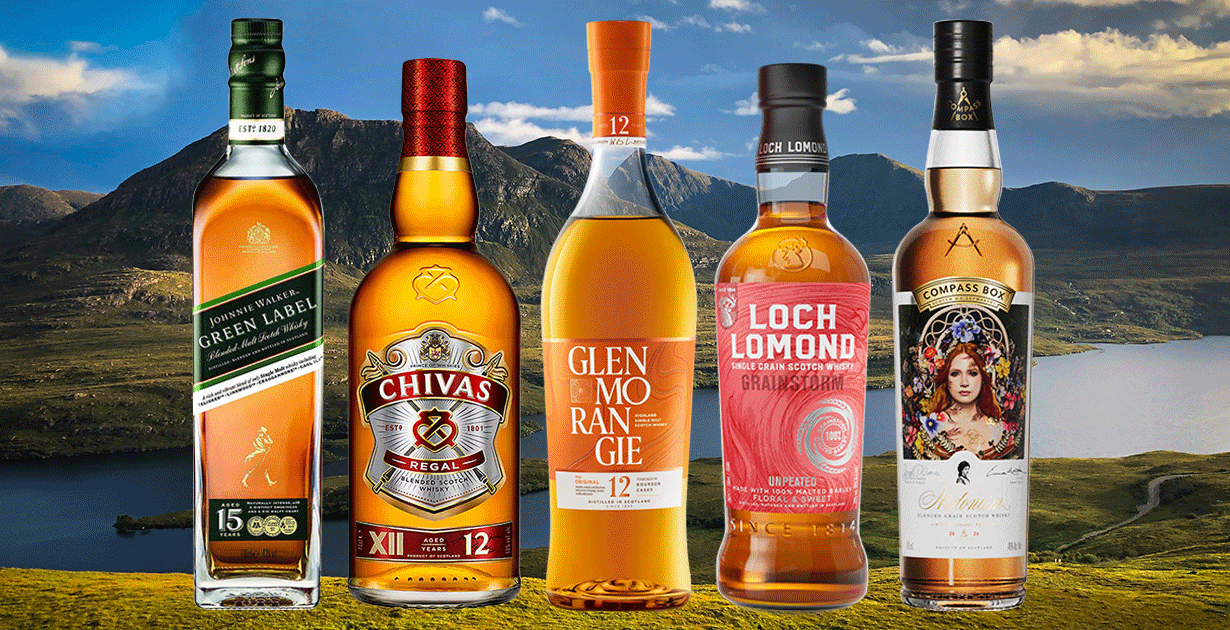
In simple terms, malt whiskies from more than one distillery are blended together for flavour. Johnnie Walker Green Label is probably the most famous example, alongside several releases from Compass Box and Douglas Laing.
The flavours can vary massively, from light and easy-going to smoky, rich, and quite full-on. Like blended Scotch more generally, blended malt gives whisky makers the chance to take different things they love and put them together to create something new.
Blended Grain Scotch Whisky Rules
Blended grain Scotch whisky works in the same way as blended malt, except the components are single grain whiskies rather than single malts.
There are not many whiskies of this type around, although Compass Box Hedonism is probably the best-known example. This style gives blenders the chance to bring together older grain whiskies and create something rich, sweet, and balanced.
Older grain whiskies are usually much cheaper than older malt whiskies, so blended grain can offer serious age and depth for a fraction of the price of comparable malt whisky.
…Single Blend?
I bet only some of you saw this one coming.
The Scotch Whisky Association does not like the labelling term “single blend,” as it believes it can cause confusion. I can see why, although it is something you rarely see.
A single blend is a combination of malt and grain whiskies made at the same distillery. So, there is no outsourcing of whisky from other sites required. In Scotland, the only distillery I know of that has produced one is Loch Lomond. I have never tried it, but it does exist.
What About Peated Scotch Whiskies?
Peat comes into play before distillation. That means a single malt, and more rarely a single grain, can be peated.
If any of the styles above contain peated whisky, there will usually be some indication of that on the bottle or box. Single malts famous for being peated, such as Laphroaig or Ardbeg, tend to say they are peated, richly peated, or heavily peated somewhere on the label.
As always, read the label.
Scotch Whisky Is More Varied Than You Think
Scotch whisky has far more variety than many people realise. It is not all single malt and blended Scotch. There are several different categories, each with its own rules, production methods, and flavour possibilities.
From lighter grain whiskies to smoky single malts, rich blended malts, and unusual single blends, Scotch whisky covers a much wider flavour spectrum than it is often given credit for. Once you understand the categories, it becomes much easier to understand what is in your glass.