







On October 8 the Welsh Whisky Association signed a statement defending “the integrity of the Single Malt category.” Its own registered rulebook does not yet contain the safeguard that statement is defending.
The Welsh association issued the statement jointly with the Scotch Whisky Association (SWA) and the Irish Whiskey Association, on the day the SWA appealed against the English Whisky geographical indication (GI), which entered the UK register on October 1. The dispute turns on one clause, which lets Single Malt English Whisky be mashed and fermented anywhere in England so long as it is distilled at a single distillery. The SWA argues that this breaks the link between a single malt and a single place. The rules of five whisky-making countries show that there is no single legal meaning of “single” to break, because each one draws its line around a different set of production stages. Scotch draws its own line more selectively than the SWA’s argument suggests.
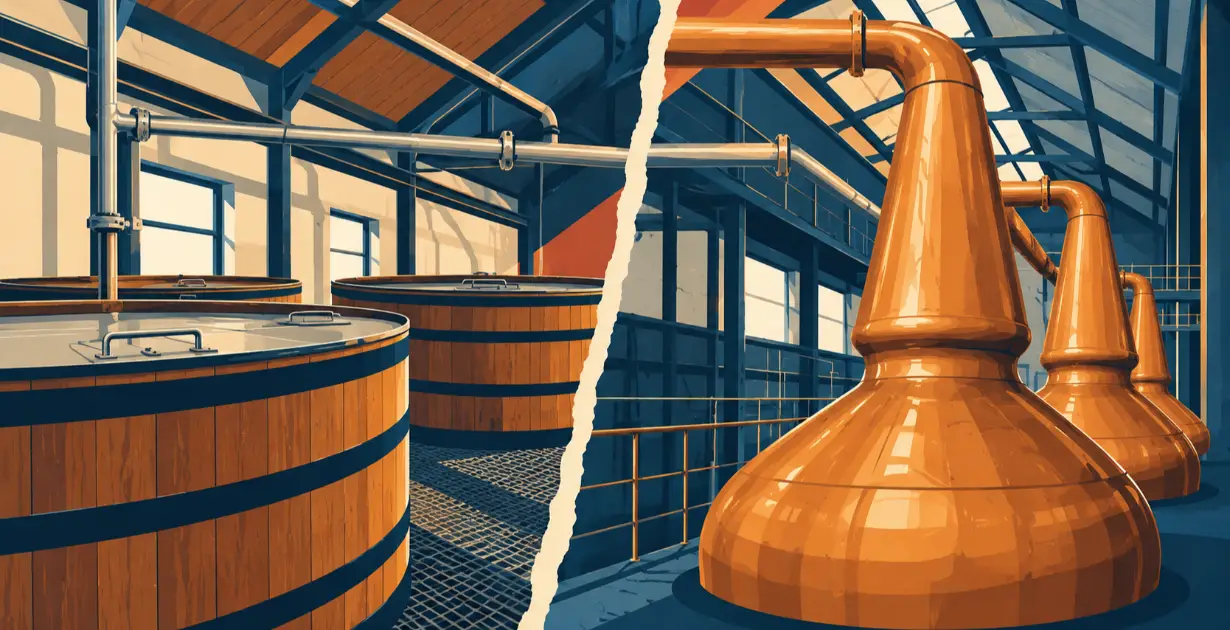
The gap opens in the English specification, at the point where the brewhouse and the stillhouse are allowed to part company.
What the English Single Malt Rules Allow
The English specification follows years of pressure from producers for official English whisky standards. It defines “Single” as whisky “produced at a single English distillery,” and later requires all of it to be “distilled at a single distillery (site).” Mashing, fermentation, distillation and maturation must all take place in England, but the text does not require mashing and fermentation to happen at the distillery that runs the stills.
 Trending Content



On grain, the English rules are stricter than the Scotch ones, because every grain used, malted or unmalted, must come from a UK farm. Morag Garden, chief executive of the English Whisky Guild, calls that “a commitment that sets it apart from other whisky standards around the world.” Malt whisky must be batch distilled at least twice, with at least one pass through a pot still and “sufficient copper contact in the vapour path.” According to the government’s decision notice, the copper clause, not the mashing question, was “the principal area of contention” among the seven oppositions it received.
The SWA set out its objection in a statement supplied to us. It said the GI “allows Single Malt English Whisky to be mashed and fermented away from the distillery, breaking the crucial connection with single site and place.” The association said it was appealing “to protect the Scotch Whisky industry’s huge investment in the high quality and reputation of the single malt category,” and it will not comment further while the appeal is underway.
What Will Whisky Look Like in 2027? Voices from Whisky Live Paris
READ THE STORY“[The English Whisky GI] allows Single Malt English Whisky to be mashed and fermented away from the distillery, breaking the crucial connection with single site and place.”
Garden argues that the clause simply writes down how part of the industry already works. “The English Whisky GI codifies existing practices in the English Whisky Industry, such as the definition of Single as set out in the now approved GI,” she told us. “Without the English Whisky GI these practices would continue without any regulation.” She traces the practice to the start of modern English whisky in 2003, “with Hicks and Healey producing wort at St Austell Brewery,” and says that of England’s 70 distilleries, the dispute concerns “a subset of 12.”
“Without the English Whisky GI these practices would continue without any regulation.”
How Scotch Defines Single Malt, and Where It Stops
The SWA’s distinction is real, because Regulation 3 of the Scotch Whisky Regulations 2009 requires malted barley to be “processed at that distillery into a mash,” converted there and “fermented at that distillery only by the addition of yeast.” A Scottish distillery that bought in wort from a brewery could not sell the result as Scotch malt whisky at all.
That boundary is narrower than the phrase “single site and place” implies. The regulations require maturation “only in Scotland,” in an excise warehouse or permitted place, and they do not require it to happen at the distillery. They also set no requirement to use Scottish barley, and the SWA’s own Cereals Technical Note says there has never been one, noting that distillers normally buy their malt from commercial maltsters.
In Everything You Need to Know About Whisky, the whisky historian Nicholas Morgan describes how malting moved out of individual distilleries into “large industrial facilities that service a number of makers,” and most floor maltings were abandoned in the 1960s and 1970s. At that stage of production, he writes, “it is the accountant, not the distiller, who calls the shots.” Scotch let one stage of whisky-making leave the distillery generations ago and drew its legal line at the next stage.
The SWA’s stronger case rests on integrated control, because a distillery that mashes and ferments its own wash keeps every step before the stills in the same hands.
“it is the accountant, not the distiller, who calls the shots.”
Single Malt Rules in Ireland, Wales and America
Ireland’s rules sit closest to Scotland’s, with Revenue’s verification guidance for the Irish Whiskey GI stating that producers “must carry out brewing, fermentation and distillation at the same premises.” Spirit may still move between verified facilities for maturation or bottling.
The American Single Malt Whisky standard of identity, in force since January 19, 2025, is looser. It requires a mash of 100 percent malted barley “produced in the United States” and distillation “at the same distillery in the United States,” with aging in oak casks of no more than 700 liters. It does not require mashing to happen at the distillery, and it is a federal labeling standard rather than a GI.
The Welsh GI, registered in July 2023, defines Single Malt Welsh Whisky by distillation at a single Welsh distillery and requires mashing, fermentation, distillation, maturation and bottling to take place in Wales. The published specification does not expressly tie mashing and fermentation to the distilling site, which places the current Welsh text closer to the English one than to the Scotch. Garden makes the same point, saying the English GI “closely follows the approach already adopted within the Single Malt Welsh Whisky GI and the US standard.”
The Welsh Amendment That Complicates the Picture
The Welsh Whisky Association has itself been trying to close that gap. Earlier this year it applied to add “mashing and fermentation as mandatory production stages” and “a requirement for these stages to occur at the same physical distillery where distillation takes place.”
On April 27 the government rejected that application on procedural grounds, without ruling on the policy itself. Its decision notice said both changes “could exclude potential producers” from the GI and so could not go through the quicker standard amendment route. Government records indicate that the association filed a fresh application under the slower non-standard procedure in September, and its text has not yet been published for comment.
The Guild’s comparison holds for the Welsh rules as written, though not for the rules Wales now wants. Wales is asking for the same rule the SWA is defending, which explains its signature on the joint statement, and its application shows that the rule is a recent ambition there rather than settled law.
Who Decides What Single Malt Means
According to the joint statement, the associations offered the English Whisky Guild compromises, which were not accepted. The associations also say they remain concerned about “inconsistencies in approving the English Whisky GI, both in terms of process and future practice.” That wording suggests the appeal may turn on procedure as much as on what a single malt is, and the grounds lodged with the First-tier Tribunal have not been published.
Garden finds the objections “slightly bewildering” and says “the strength of the opposition seems both misplaced and somewhat over the top.” She would rather the argument turned to what she calls the “genuinely ground-breaking elements” of the standard, among them a flexible wood policy and permission to use “contemporary distillation technology and modern still designs.”
The standard’s openness to new still designs has its limits. On October 8 a DEFRA spokesperson told The Spirits Business that Spirit of Birmingham, whose stills reportedly fail the copper-contact rule, could no longer use “single malt English whisky” but could still call its product “English whisky” or “single malt whisky.” That remark sits uneasily with the GI’s protection of the name English Whisky itself, and the department has not explained how the two positions fit together.
In March 2025 Darren Jones, then Chief Secretary to the Treasury, told the Commons that the government would “not be watering down the definition of single malt whisky.” The English GI left the Scotch rules untouched, but it put a second and looser use of the same two words on British shelves.
“not be watering down the definition of single malt whisky.”
What the Single Malt Appeal Means for Drinkers
Nothing on the shelf changes straight away, and a Scotch single malt will still be mashed, fermented and distilled at one distillery. An Irish single malt will still be verified to the same standard, as will English single malts from most of the country’s distilleries, but the 12 the Guild says the dispute concerns work differently. The label will not tell shoppers which is which, and no reliable survey yet shows whether they assume the stricter meaning when they see the word “single.”
The outcome now depends on the tribunal and on the quieter Welsh application. If Wales wins its amendment, three of the four whisky GIs in Britain and Ireland will tie the mash tun to the still, which would leave England as the outlier and strengthen the SWA’s claim to a shared standard. If the tribunal upholds the English GI as it stands, the word will promise something different depending on the country named next to it.
For now, what “single” means in a single malt depends more on the border the whisky was made inside than on the whisky itself.