Whisky is usually thought of as something to sip, not something that changed the course of history. Yet it keeps turning up at pivotal moments, and one of the most surprising is its part in giving the world’s whales a reprieve.
Lighting the World with Whales
Go back to the early nineteenth century. Then as now, whoever controlled fuel shaped the economy, and the fuel that lit America’s homes and streets came from whales.
Whale oil lit street lamps, parlours and lighthouses. It was far from perfect. The cheaper grades gave off an acrid smell and sooty smoke, and the best oil, from sperm whales, was expensive and getting more so. Whalers had to sail ever further, on voyages lasting years, to find animals that hadn’t already been hunted out. The world was running short of whales, and short of light.
The answer came from an unlikely place: a salt business in Pennsylvania.
A Salt Man with an Oil Problem
Salt was valuable in nineteenth-century America, and Samuel Kier’s family drilled brine wells near Tarentum, outside Pittsburgh, to produce it. But the wells kept bringing up something nobody wanted: a thick, black, foul-smelling liquid. Crude oil.
To Kier it was a nuisance. It fouled the brine, slowed production and ate into profits. At first it was simply run off into the Pennsylvania Main Line Canal, and it was a fire hazard on top of everything else.
Kier was an entrepreneur, though, and he wondered whether this waste could be sold. He bottled it as “Kier’s Rock Oil,” a cure-all for everything from rheumatism to liver complaints, and sent salesmen out with wagons to sell it. It was a petroleum tonic at half a dollar a bottle, and it never sold in the quantities he hoped.
Enter the Whiskey Still
The real breakthrough came when Kier asked a different question: could this stuff burn in a lamp?
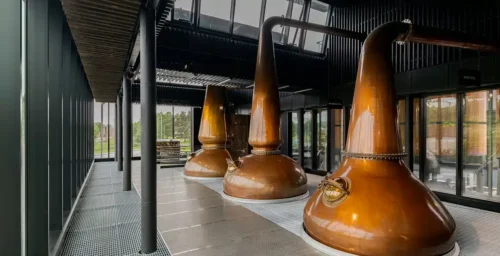
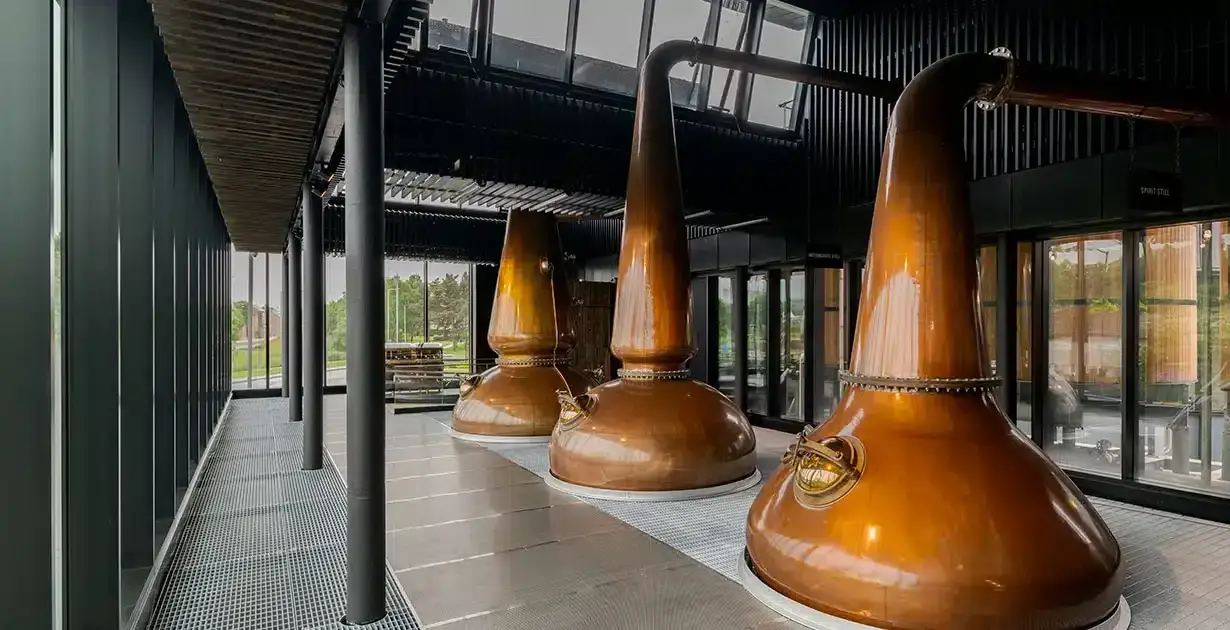
He sent samples to the Philadelphia chemist James C. Booth, who advised him to distil it. And the technology to do that was close at hand. Western Pennsylvania was whiskey country, full of distillers and their stills. Kier took the same principle (heat a liquid, collect the vapours, condense them) and applied it to crude oil.
Around 1851 he began producing a clean-burning lamp fuel he called “carbon oil,” an early version of what we now call kerosene. It burned brighter than cheap whale oil, smoked less, and above all it was cheap and plentiful. By the mid-1850s Kier was running what is widely considered America’s first oil refinery, in Pittsburgh, built around a simple still.




Same Science, Different Spirit
Kier’s leap makes sense once you look at the chemistry. A whiskey distiller and an oil refiner do the same basic thing: they heat a complex mixture and separate it according to the different boiling points of its parts. The distiller is after alcohol and flavour, cutting away heads and tails. The refiner is after usable fuel, separating it from the heavy residue and the volatile fractions.
Modern refineries use towering fractionating columns, but the principle is one any stillman in Speyside or Kentucky would recognise. In a real sense, the whiskey still was the oil refinery’s ancestor.
From Kier to Drake
Kier is often called the “grandfather of the American oil industry,” and the title is fair. His success showed that crude oil was worth something, and it caught the attention of investors. In 1859 Edwin Drake struck oil at Titusville, Pennsylvania, with the first commercial well drilled specifically for petroleum. The oil rush that followed turned kerosene from a novelty into the world’s lamp fuel.
Whale oil couldn’t compete. Demand collapsed over the following decades, and the great American whaling fleets dwindled.
Why Oil Comes in Barrels
The new industry had a practical problem: how do you move all this oil? The answer was sitting in every cooperage in the country. Producers filled whatever sturdy, watertight wooden barrels they could get, many of them whiskey and wine casks. In 1866 Pennsylvania’s oil producers settled on a standard 42-gallon barrel.
Oil hasn’t travelled in wooden barrels for well over a century, but the unit stuck. Every time you hear the price of crude quoted per barrel, you’re hearing an echo of the cooper’s workshop.
A Reprieve, Not a Rescue
A word of honesty before we raise a toast. Kerosene took the pressure off whales in the nineteenth century, but it didn’t save them. In the twentieth century, factory ships and explosive harpoons killed whales on an even bigger scale, this time for margarine, soap and other industrial uses. Real protection only came with international bans on commercial whaling in the 1980s.
Still, for a few crucial decades, a borrowed whiskey still helped turn the world’s lamps away from the oceans. Not bad for a technology invented to make spirit.