

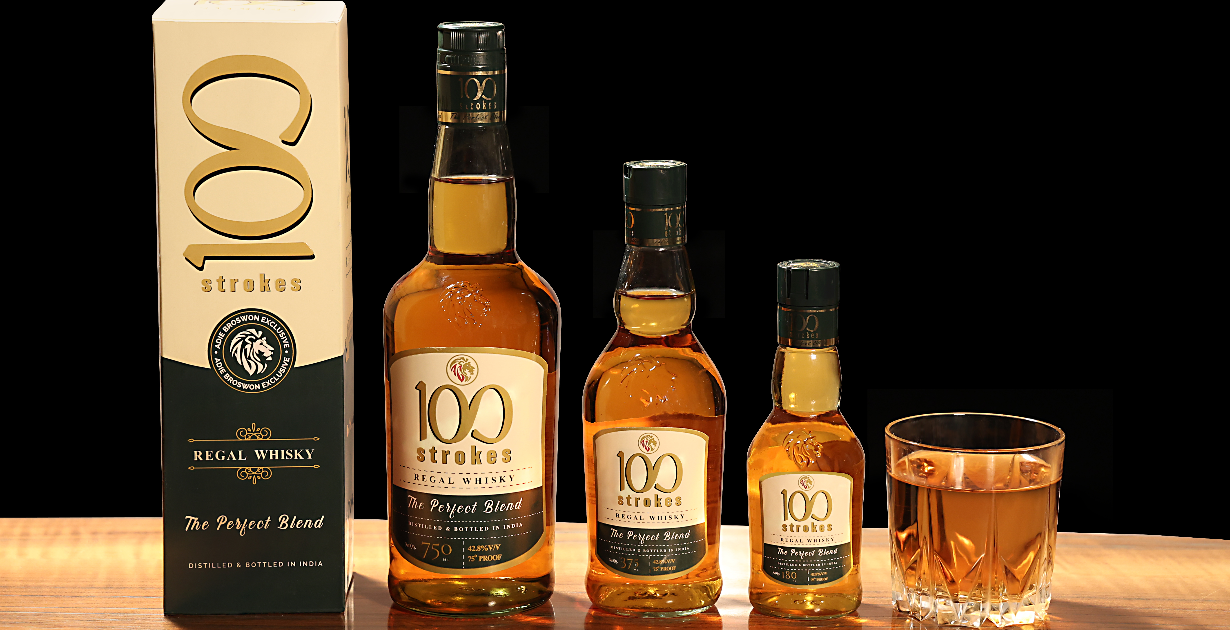
The Adie Broswon Group has launched its 100 Strokes Whisky brand in Punjab, Uttarakhand and Rajasthan. The move extends the whisky’s reach beyond Delhi and bolsters its presence across key markets in North India.
100 Strokes carries the proposition “Refined by Ritual.”
The brand is built around the concept that mastery comes through patience, precision and consistency. It draws inspiration from the discipline of an artist, the focus of an athlete and the craftsmanship of a master blender; the finest results are shaped gradually, through attention to detail and a commitment to refinement.
The whisky is produced using demineralized water, ENA, Vatted Malt Spirit from Scotland and select flavors. These components are combined through a carefully controlled blending process.
According to the official notes from the brand, the whisky has a smooth and well-rounded flavor profile. It carries warm notes of spice and caramel, complemented by subtle hints of honey and vanilla.
The product targets consumers who want an approachable whisky but still value craftsmanship and consistency. Its positioning blends an accessible drinking experience with a narrative centered on patience, balance and the pursuit of mastery.
For the company, the three-market expansion forms part of a wider strategy to scale its spirits portfolio across important consumption markets. With the brand already established in Delhi, Adie Broswon is now taking 100 Strokes to a broader consumer base across the region.
100 Strokes Whisky is available in 750ml, 375ml and 180ml formats. Pricing for the 750ml bottle varies by state, reflecting India’s state-level excise and taxation structures.
In Punjab, the 750ml bottle is priced between $5.60 and $7.30 (₹500 / ₹650). The same format sells for $7 (₹620) in Rajasthan.
Pricing in Uttarakhand sits between $7.30 and $7.90 (₹650 / ₹700). The whisky is currently sold across Delhi, Punjab, Uttarakhand and Rajasthan, alongside other select markets.

India remains one of the world’s largest whisky markets by volume, with domestic blended brands accounting for the bulk of consumption. The segment continues to attract new launches as producers compete for share across the country’s regionally regulated markets.