


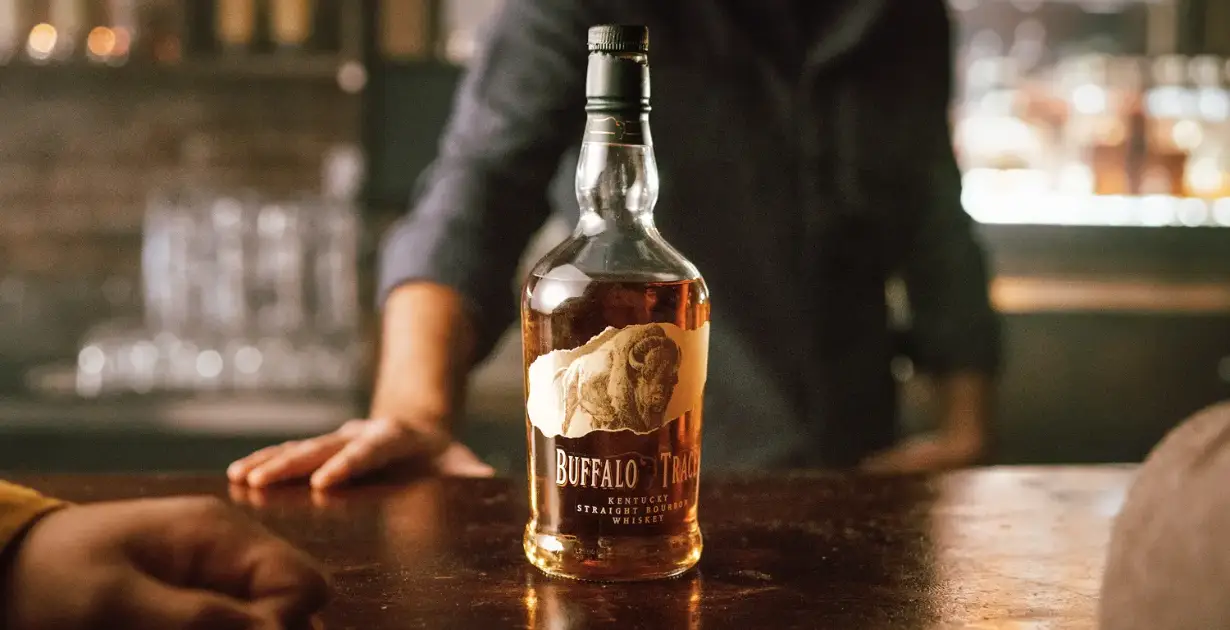
Buffalo Trace is one of the most familiar names in American whiskey, and it comes from the same Kentucky distillery that makes Pappy Van Winkle, Blanton’s, and George T. Stagg. Unlike those bottles, it was never meant to be a collector’s item. It’s priced as an everyday bourbon, the kind of bottle most people would expect to pick up on a routine trip to the liquor store. In many parts of the US, though, finding one can be difficult.
British drinkers would find this story hard to recognize. In the UK, Buffalo Trace sits on supermarket shelves and goes on sale often enough that it can come in cheaper than it does in America.
So, why is it that Buffalo Trace’s flagship bourbon is so hard to find in the US, but so easy to find in the UK? Let’s take a look at the economics of Buffalo Trace, state-level distribution, and how decisions made years ago impact availability today.
Quick whisky question
Single malt is everywhere, but what does it mean? We want to know what the word “single” means to you. Three quick questions, under a minute.
How Buffalo Trace Ran Short of Bourbon
Bourbon takes years to mature, so the whiskey going into a bottle of Buffalo Trace this year was distilled long before anyone knew how many people would want to buy it.
The flagship doesn’t carry an age statement, but the distillery has said it ages many of its whiskeys for “eight to ten years,” which means the bottles on shelves now depend on how much bourbon went into barrels around the early 2010s.
When the site became Buffalo Trace in 1999, running short of whiskey wasn’t something anyone there expected. Master distiller Harlen Wheatley told Smiley Pete in 2025, “In 1999, we didn’t really think that we would ever get to the point where we would have to expand. It was a pretty full-size industrial site with a capacity so big that it wasn’t fully utilized.”
What Will Whisky Look Like in 2027? Voices from Whisky Live Paris
READ THE STORYBourbon grew far more popular over the following years. In 2013, Buffalo Trace looked at its inventory, current sales, and 20-year projections and found that “fans were drinking more bourbon than the company had predicted,” according to a statement the distillery released in 2018. By 2014, Sazerac president Mark Brown put the shortfall at around 100,000 barrels.
A distillery can increase production in a single year, but it can’t speed up the aging of whiskey it never made, so the gap couldn’t be closed quickly.
Buffalo Trace wasn’t the only distillery caught out this way. Knob Creek ran short in 2009 and later spent a few years without its nine-year age statement for similar reasons, as we covered in our look at Knob Creek 9 Year Old.
What Buffalo Trace Has Said and What It’s Doing
Buffalo Trace has issued several public statements about the shortage over the years. Its first press release on the subject, in May 2013, warned that “there could be temporary product shortages, even on favorites like Buffalo Trace and Eagle Rare.”
In August 2014, the distillery said, “Every single one of our bourbon brands is currently on strict allocation,” and in 2017 it told The Spirits Business its allocations would continue with “no foreseeable end in sight.”
The longer-term fix was a $1.2 billion expansion, which Sazerac began in 2015 and completed in January 2025. It raised production capacity by 150%. The distillery went from making 200,000 barrels a year to nearly 500,000 and added 19 new warehouses.
Importantly for drinkers, Buffalo Trace decided not to raise the prices of its bourbon.
How Buffalo Trace Bourbon Is Allocated
Like most spirits in the US, Buffalo Trace reaches drinkers through the three-tier system. The distillery sells to distributors, distributors sell to retailers, and retailers sell to the public. When there isn’t enough bourbon to go around, it gets shared out at each step.
The distillery has previously allocated limited numbers to each state to ensure that everyone got at least a small chance of buying Buffalo Trace Bourbon.
Once the bourbon leaves the distillery, decisions about which stores receive it are largely out of the distillery’s hands. In Pappyland, published in 2020, Wright Thompson writes that the Van Winkle family, whose bourbon is also made at Buffalo Trace, “have no say over who gets their whiskey or over how much retailers charge for it.”
In states where the government runs liquor sales, the price is fixed but the supply is still limited. For example, Virginia’s state-run stores sell Buffalo Trace for $28.99, and a tracker of their inventory lists it as hard to find. Elsewhere, some retailers sell sought-after bottles as part of bundles with other products.
In its 2015 inventory update, the distillery said, “Although some stores may charge a premium for Buffalo Trace’s limited brands, the Distillery is not asking them to do so.”
Overall, though, the markup on the flagship itself is fairly small. For most people, the real cost of Buffalo Trace is the time spent looking for it.
Why So Many People Want Buffalo Trace
Part of the appeal is the company it keeps. The distillery also makes Pappy Van Winkle, Blanton’s, and the Buffalo Trace Antique Collection, and the flagship is made from the same recipe, known as Mash Bill #1, as Eagle Rare, E.H. Taylor, and George T. Stagg.
Interest in one bottle can spill over to others. In American Whiskey, Richard Thomas describes how W.L. Weller 12 Year Old, a wheated bourbon also made at Buffalo Trace, became hard to buy after food writer Josh Ozersky labeled it “baby Pappy Van Winkle” in 2014.
The flagship has a good record of its own. Buffalo Trace’s awards page lists a Double Gold at the San Francisco World Spirits Competition in 2009, a Gold there in 2018, and a Gold at the World Whiskies Awards in 2020.
Put those things together, and the flagship follows a similar pattern to Weller. It’s one of the most affordable and widely distributed bottles from a distillery known for whiskey most people will never get to try, and it’s a reliable bourbon in its own right. When bourbon’s popularity took off, it was an easy bottle for new drinkers and curious fans to reach for, and demand grew faster than the distillery had planned for.
Why Buffalo Trace Is So Easy to Find in the UK
In Britain, Buffalo Trace is sold as a regular supermarket bourbon. Tesco, Sainsbury’s, and Waitrose all stock it, and it was discounted to £19 at Amazon and Asda earlier this year. The UK bottle is also slightly different, at 70cl and 40% ABV rather than the 750ml and 45% sold in the US.
Sazerac supplies British retailers through its own company, Sazerac UK, so the bourbon doesn’t pass through the American three-tier system on its way to the shelf. Only a small share of Buffalo Trace leaves the US, but there’s far less competition for those bottles in Britain, where bourbon doesn’t attract the same crowds of hunters. However, many bourbon brands are looking to change that. Buffalo Trace opened a London location in May 2024.
Is Buffalo Trace Worth the Hunt?
Among bourbon fans, the usual view is that Buffalo Trace is a good everyday bottle at its regular price, but not one worth paying a markup or making a special trip for. There are plenty of good quality bourbons at the same price as Buffalo Trace that are much easier to find: Evan Williams Bottled-in-Bond, Wild Turkey 101, and Elijah Craig Small Batch, to name a few.
The good news, though, is that it may be getting easier to find. The Morning Drive says “the broader Buffalo Trace shelf presence feels more normal than it did a few years ago.” So, maybe the future will bring us a steadier supply of Buffalo Trace Bourbon, and it can return to its status as tasty, affordable, and accessible.
If you’d like to know more about what the distillery makes, take a look at our complete guide to every whiskey made at Buffalo Trace.
 Latest On The Whiskey Wash