

For those whisky aficionados who don’t know about the illustrious history of Springbank’s Local Barley releases from the 1990s up through the mid-2000s, it’s worth mentioning that a benchmark for extraordinary quality was set on a series of batches from 1965 and 1966 that used barley sourced locally (within a few miles of Springbank). Oftentimes, the name of the actual farm was listed.
Some of these epic batches were over thirty years of age. The really old ones tend to be quite dark, almost the color of mahogany. I’ve never tasted one, but I’ve drooled over pictures online. In fact, they remind me of a few bottles of Gordon & MacPhail Glen Grants from 1966 that were up on Binny’s website for a year before finally selling out. I nearly bought one, since I was born in 1966, but there weren’t any reviews to help me decide, and so I balked.
Now, the reviews are out, and, overall, they are pretty darned tantalizing. I also saw a 1966 bottle of Springbank up on The Whisky Barrel a few years ago. It was from Douglas Laing’s Director’s Cut series. That one was a no-brainer. The price was right and I really messed up not snagging that bottle. As for the Glen Grants, well, they were more hit and miss. A few of them were said to taste like soy sauce, and I’m not a big fan of that flavor in my whisky.
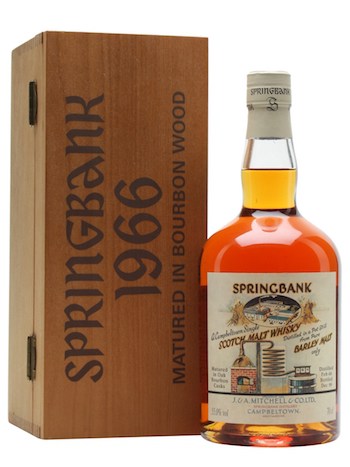
Serge Valentin of Whiskyfun.com rated Springbank Local Barley Cask 507 1966/1999 at 94 points, which is about as high a rating as I’ve ever seen on his website. Bottles from that cask had a luxurious 55% ABV, which is fairly high for a cask strength whisky that is 33 years old. I can only assume that Freemasons bought out that one due to the auspicious years involved. Just kidding.
But seriously, the last few bottles from that run fetched upwards of four thousand dollars, especially after Serge’s review came out. If you think that folks are edgy about spending four hundred dollars on an unknown commodity (without any reviews online), try ten times that amount. One favorable review from an experienced and respected critic like Serge can make all the difference in some cases.
However, by the time his glowing words hit peoples’ screens in September of 2008, the Local Barley series was already mopping up the floor. I knew about the hype back then, but I still didn’t move on the bottles. Today, I’m kicking myself yet again. That’s why I jumped at the chance to snag a bottle of the new run of Local Barley from Springbank.
Meanwhile . . . Fifty Years Later
In theory, at least, the 2016 release of Springbank’s 1999 Local Barley was made in the proud tradition of those elder batches from the mid-60’s. Okay, so it hasn’t been brooding in dunnage warehouses for three decades, but half that long ain’t bad in my book. Neither does it offer scents and tastes of cola, beef stock, black tea, or even eucalyptus for that matter—all of which are present in various batches of the really old stuff.
But the new stuff is extraordinarily good for a Springbank, and well worth the price, especially if you can snag it for the equivalent of, say, $165—which is where the prices start on Wine Searcher at the moment. For that price, it’s still a steal, in my book.
 Trending Stories

Ironically, the very elements that make the older batches from the mid-60’s so appealing might actually turn off more than a few folks today who consider themselves whisky mavens. How many people relish the idea of toad stools, paraffin, coriander, or balsamic vinegar in their Scotch? Well, okay, I certainly would LOVE to taste these things. Then again, I’m obsessed with single malt Scotch.
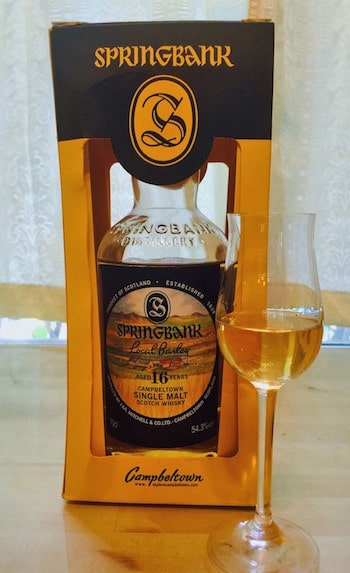
In all fairness, many of the elements present in the Local Barley 1965/2001 Cask 65/9 ARE in the new stuff. Yes, we’re talking about sweet notes, such as honey, vanilla, butterscotch, and golden raisins—but also industrial notes, such as paraffin, along with more organic influences of smoky peat, damp wool, and earthen floors of dunnage warehouses.
In other words, there are plenty of parallels with at least a few batches of the older Local Barley to warrant the nom de plume, in addition to the fact that, well, the whisky was indeed made with barley sourced from farms near the distillery—“local” farms. In this case, we’re talking about Low Machrimore Farm, in Southend of the peninsula.
As with all Springbank whiskies, the barley is prepared using traditional floor malting methods. This is something of a rarity, owing to the fact that in-house floor malting can be tedious, labor intensive, and fairly time consuming. So, yes, Local Barley 16-Year-Old is unique when compared with the way most other whiskies are malted, but not when compared with other Springbanks. As for its kilning, milling, and mashing–all of these stages of whisky making were also done on the premises.
Tasting Notes
Color: Pale gold
Nose: Upon first whiff, a cozy malt presence reminds one of damp wool. Prominent in the profile, a mineral note of soft paraffin, also known as petroleum jelly, wafts up in the glass. This element has been compared with engine oil, but I wouldn’t go quite that far on the spectrum of “dirty.” Sweet peat follows, along with cigar ash. There’s a bit of Springbank’s infamous dunnage warehouse fustiness. Oh yeah, this dram is complex, alright. Really fun. As the spirit breathes, it offers lemon drops, honey, vanilla ice cream, and some grapefruit.
Palate: Classic interplay of malt, a little smoke, and sultana. I’m reminded of a glass of Springbank 10 Year 100 Proof that I savored last year. However, I must say that Local Barley 16 Year Old is more mature, and even more “old skool,” if you can believe it. The composition is so masterfully executed that it tastes a little different with each sip. Such variability reveals a master stroke of craftsmanship.
Upon one’s tongue, the malt turns sweet right away with some overtones of vanilla bean and caramel sauce drizzled on cheesecake. Industrial notes are not far behind with hints of furniture polish and the kind of mineral oil used to sharpen knife blades. Some fruitiness also comes into play with dried apricot. Lastly, one is left with an oceanic form of saltiness that seems to evoke some batches of the 1960’s Local Barleys.
In the finish, there’s a hint of heather honey that I tasted recently in a 30 year old Highland Park. I wouldn’t categorize the finish as bitter, and yet it moves through a green sappy vegetal note that seems almost bitter, but not quite. This compliments sweeter overtones from the palate remarkably well. A phantom savory note, as of marbling on a fire roasted rib-eye steak, is present at the death, for those who have the ability to detect it.
Influence of water: On the nose, water eliminates the damp wool scent right off the bat. One is left with a more austere grassy, mineral impression–along with a foundation of malt and some peat, as might be expected. In the mouth, water also simplifies things. The broth is reduced to light caramel, wet moss, and very little in the way of stone fruits (no more dried apricots). But I do still get a hint of lemon rind, along with a wee bit of grapefruit. Local Barley 2016 is more citrusy with water, in other words.
Some whisky critics have announced that Local Barley 16 Year Old takes water quite well. Since I employ a dropper to add water, I was able to try the whisky with a few drops, and then to add a few more, and a few more– sipping as I went, as time slowed down–until my glass had reached nearly a teaspoon’s worth. For me, that was well over the limit of what I would advise.
Of course, the addition of water, especially into cask strength whiskies, is really a matter of individual taste. But for heaven’s sake, don’t water-log your precious charge in one fell swoop! When it comes to water, less is more with this one. A few drops can relax Local Barley’s very respectable 54.3% ABV without stripping away all of the amazing subtleties.
Conclusion and Cost Analysis:
Local Barley does succeed in evoking an old-school form of craft-oriented whisky. I’m amazed this stuff is only sixteen years old. There must be some older casks in the batch. Yes, it definitely tastes older to me at times. Springbank’s magickal broth has the power of sixteen years, and the charismatic charm of twenty years.
In fact, as I said, I was reminded at one point of the latest release of Highland Park’s 30-Year-Old, and that is high praise considering how high I rated that one!
Few releases have piqued as much attention this year among whisky nerds as this release. The run produced 9,000 bottles. It’s interesting to point out that, like most Springbank bottlings, the Local Barley started out at a very low price that hovered around $117. After the initial shipments had sold out (in hours), distributors raised the rates considerably.
As of the writing of this review, the average cost in the United States is around $190. In the UK, meanwhile, what’s left in shops there is pricing slightly lower at around $160 USD. Once supplies dwindle around the planet, we can expect to see the price go up dramatically. I predict one bottle will fetch between $400-500 at auction once 2016 Local Barley 16 Year Old becomes collectible due to two factors: scarcity and desirability.
In other words, even if $200 seems excessive, now is the time to buy (see our buy link at the end of this article on where to pick up a bottle). As for qualms about pricing on Springbank, David Allen, a spokesperson for Springbank Distillery, went on record a few months ago as stating that the core ranges have not been increased in two years.
Here in my home state of Oregon, Local Barley 16-Year-Old will probably never see the light of day. However, the Springbank 12-Year-Old Cask Strength costs $110, whereas prices on Wine Searcher hover between $80-100. Springbank 15-Year-Old costs $126 in Oregon, and between $70-80 in the UK. A Springbank 18-Year-Old Official Bottling costs $244 here, and yet it sells for a little over $100 across the pond in London.
What’s more, according to my research, I’ve found there are websites in the UK that will ship an order of four bottles for an approximate cost of $60 to states in the USA (which allow shipments). I contacted one prominent online purveyor of whisky (which shall remain anonymous) for comment, and its representative told me that costs escalate on limited bottlings, such as Local Barley 16-Year-Old, due to outsourcing from third party distributors.
Personally, I think that the best way to get around double, triple, or even quadruple “middle man” price inflation would be to encourage cooperative international legislation that allows one or two bottles per year to be shipped from a distillery to folks who “belong” – such as the proud members of Springbank Society.
FINAL SCORE: 93/100

 Latest News