

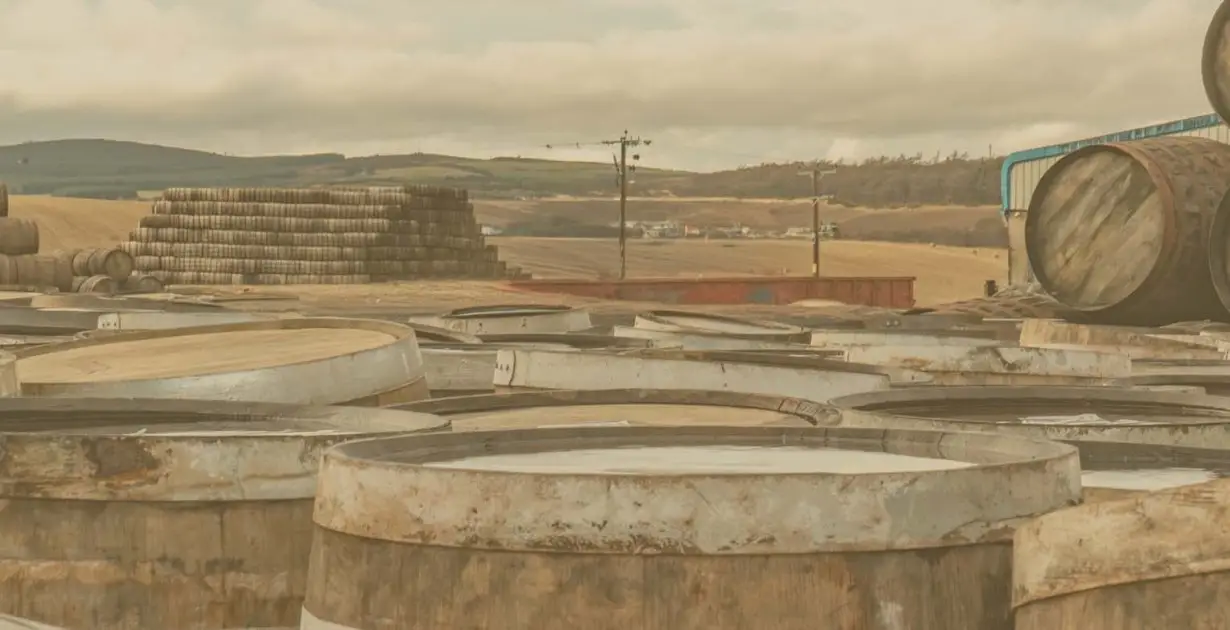
The “angel’s share” is a term used in spirits maturation for the natural loss of liquid that occurs when the spirit is maturing in a barrel. The term encompasses loss by absorption into the wood and evaporation of liquid that can cause an increase or decrease in the alcoholic strength (ABV) of the spirit over time.
The angel’s share is a natural process that is essential to whiskey’s development. The average rate of loss of volume and change in ABV varies significantly between whisky making regions. However it can also vary within a single warehouse.
Evaporation & Absorption
A wooden barrel isn’t just a container—it’s an intrinsic part of the maturation process. Some whiskey makers describe it almost like a living entity that breathes in and out as temperature and humidity fluctuates with the seasons.
What Will Whisky Look Like in 2027? Voices from Whisky Live Paris
READ THE STORYWooden barrels are porous, this allows some of the whiskey to evaporate, but some is also absorbed into the wood itself. The interaction with the wood and air shapes the whiskey, building colour, but also shaping and building flavour compounds over time.
The rate of the angel’s share varies dramatically depending on where in the world the whiskey matures. In cooler, high-humidity climates like Scotland, Canada, and Ireland, we see an average decrease of around 2% per year. In places like Kentucky and Tennessee the rate of evaporation is higher, reaching around 6%.
In even more extreme climates, like India and Taiwan, the annual losses can reach up to 12% per year.
 Trending Content
Change In ABV
As well as impacting the rate of total evaporation the local climate has a huge impact on how the alcoholic strength of the final whiskey changes. This has significant impacts on how long you can mature a whiskey in different regions.
In cool humid environments like Scotland alcohol evaporates more readily than the water component of the whiskey. This leads to a gradual decrease in the spirit’s overall strength as well as a decrease in volume of liquid. In warmer, more humid environments like Kentucky it’s the water that evaporates more easily than alcohol—which means the ABV tends to go up over time.
It is important to consider these changes in ABV and total volume when looking at buying a barrel of whiskey as they shape how long you can own the barrel.
For private individuals who already own a barrel it’s important to keep an eye on the angel’s share as even two casks maturing next to each other can experience different rates of change. Understanding the angel’s share for a cask you own can help you decide when to sell.
If you want to check the fill levels in your barrel the storage warehouse should be able to help you with something known as a regauge.
Key Differences in Angel’s Share Effects:
Scotch Whisky
- Annual loss around 1 to 4% per year
- Cool, humid climate leads to lower alcohol content over time
- Longer aging periods are more feasible due to slower evaporation
- Results in more subtle, refined flavor development
American Whiskey
- Higher annual loss, around 6% in Kentucky
- Hot, humid climate leads to increased alcohol content over time
- More rapid maturation due to climate conditions
- Creates bolder, more concentrated flavors
For a deeper dive into the world of whiskey, including more insights about maturation and production, “The Complete Whiskey Course” by Robin Robinson offers a comprehensive exploration of different aspects of whiskey making.
Ready to learn more? For detailed insights and expert tips to help you navigate your whiskey investment journey download the comprehensive Whisky Barrel Buying Guide written by the team at Mark Littler Ltd.
Our colleagues over at Mark Littler Ltd have curated their most helpful articles all in one place so you can learn more about buying and owning a barrel of scotch. If you’d like to find out more about moving forward with a barrel purchase please email [email protected].
Returns on whiskey barrels are not guaranteed and the value of casks can go down as well as up.