

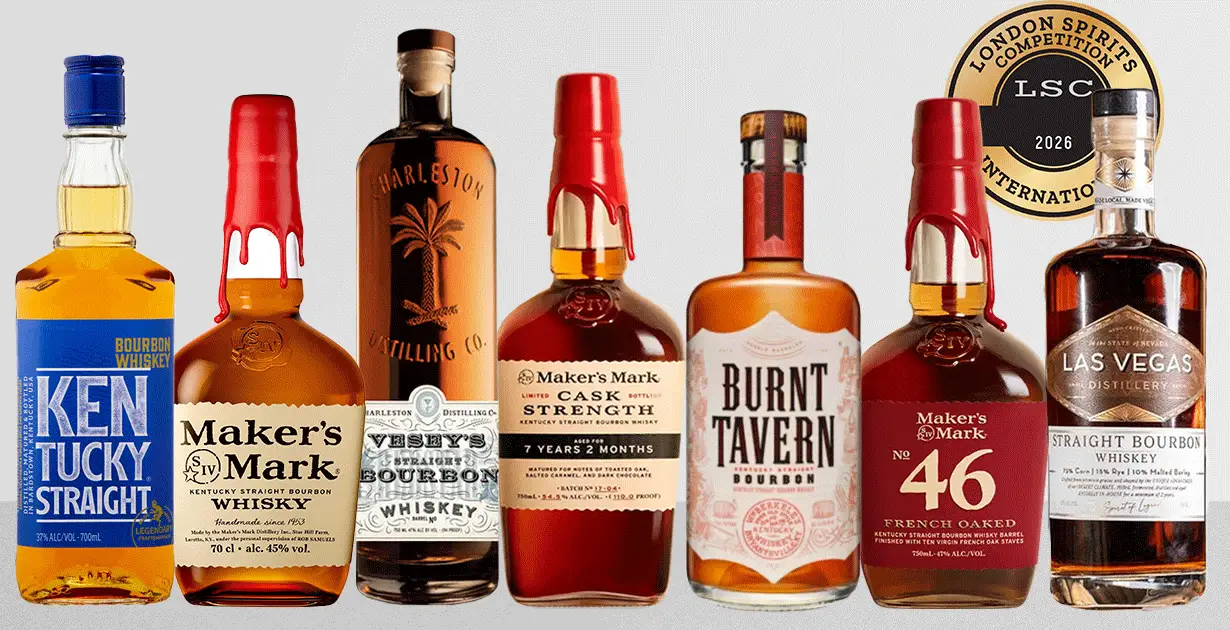
The 2026 London Spirits Competition has named its best bourbons, and the results make for unusually interesting reading.
The medal table spans a 70-year-old Kentucky institution, a Nevada desert craft distillery, a brand new Garrard County label fronted by one of American whiskey’s most respected distillers, a South Carolina grain-to-glass operation, and an Australian supermarket private label whose actual producer is anyone’s guess.
Now in its ninth year, the LSC scores entries on three criteria: taste and quality, value for money, and packaging. It’s worth keeping that methodology in mind as you read on.
What Will Whisky Look Like in 2027? Voices from Whisky Live Paris
READ THE STORYLet’s look at each winner, the tasting notes the judges singled out, and the story behind the bottle.
Maker’s Mark Bourbon Cask Strength
Score: 96
Medal: Double Gold
 Trending Content
Special Award: Straight Bourbon of the Year
Tasting Notes: “Rich and complex with notes of baked apple, raisin, and honey on the nose, complemented by toasted oak, vanilla caramel, and toasted nuts on the palate, finishing long with honey, pepper, and jammy fruit.” – LSC Judges
Find Your Next Bottle: $37

The big news on Maker’s Mark Cask Strength is that the January 2026 relaunch brought a first-ever age statement to the expression, alongside a redesigned premium glass bottle. The current batch that is listed on the Maker’s Mark website, 17-04, is bottled at 110 proof, although the ABV varies with each batch.
The bourbon comes from Star Hill Farm in Loretto, Kentucky, the home of Maker’s Mark since Bill Samuels Sr. bought the old Burks’ Distillery for $35,000 in 1953 and bottled the first batch in 1958.
Now owned by Suntory Global Spirits, it became the first working distillery in the United States to be designated a National Historic Landmark in 1980.
Maker’s Mark Cask Strength uses the same wheated mash bill as the rest of the range, 70% corn, 16% red winter wheat, and 14% malted barley, but is bottled at barrel strength. Batches typically land somewhere between 107 and 114 proof.
William Berkele Distillery Burnt Tavern Bourbon
Score: 96
Medal: Double Gold
Tasting Notes: “Rich and complex, this spirit offers aromas of dried fruits, mint, tobacco, cocoa, and leather, with a smooth, warm palate of raisin, nutmeg, toasted nuts, and stone fruit jam, finishing long, spicy, and elegant.” – LSC Judges
Find Your Next Bottle: $69.99

Burnt Tavern Bourbon constitutes the return of industry legend, Chip Tate. The Balcones Distilling founder, widely regarded as one of the most respected American whiskey makers of his generation, is the master distiller behind a brand new label that launched in 2025.
The bourbon itself is a 7 year old Kentucky straight, double barreled at Bryantsville in two slowly toasted and charred secondary barrels developed by Tate to add layers of burnt sugar, caramel, and what he and the brand describe as a whisper of smoke. It is bottled at 105 proof.
The brand is also built on a very interesting history. In the late 1700s, Rev. James Smith and his family built a travelers’ rest along Zane’s Trace in what is now Bryantsville, Kentucky. The tavern was destroyed by fire and rebuilt twice, earning its name in the process.
William Berkele founded a sour mash distillery near the site in 1868, and the current ownership group has set out to resurrect both the tavern and the distillery on the original Garrard County land.
The underlying bourbon for this first release is sourced rather than distilled on site, with Tate’s finishing work providing the brand’s signature character.
Las Vegas Distillery Straight Bourbon
Score: 95
Medal: Gold
Tasting Notes: “Bright, fresh fruit aromas of apple and peach with honey, spice, and roasted cereal notes; sharp, peppery palate with dried fruit, cinnamon, and tobacco; finish features slate, raisin, honey, and cereal nuances.” – LSC Judges
Find Your Next Bottle: $49.99

The Las Vegas Distillery story began when George Racz founded the operation in Henderson, Nevada, in 2011 as the first modern craft distillery in Southern Nevada. He personally penned the draft of the Nevada Craft Distillery Bill that was signed into law in 2013, opening the door for tastings and on-site bottle sales across the state. Racz released Nevada’s first-ever straight bourbon, Nevada 150, for the state’s sesquicentennial in 2014.
After his death, new owners purchased the distillery in 2022 and closed it for a complete two year remodel of the production space and tasting room, reopening to the public in late 2024 under Distillery Manager Cody Fredrickson.
The bourbon itself is genuinely grain to glass, with the milling, fermenting, distilling and aging all happening in house, and no sourced whiskey involved.
The mash bill is reported as 75% corn, 15% rye, and 10% malted barley. It is aged for a minimum of two years in the Vegas Valley, where the desert’s dramatic temperature swings between hot days and cold nights are credited by the distillery for accelerating the bourbon’s interaction with the barrel.
Maker’s Mark Kentucky Straight Bourbon Whisky
Score: 95
Medal: Gold
Tasting Notes: “Aromas of caramel, baking spices, and buttery corn lead to a spicy palate of black pepper, toasted nuts, and vanilla with a smooth, lingering butterscotch and light spice finish.” – LSC Judges
Find Your Next Bottle: $30

The squarish bottle and the hand-dipped red wax seal need no introduction. It has held the same recipe and the same wheated character since the first batch was filled in 1958. The mash bill, established earlier, is 70% corn, 16% soft red winter wheat, and 14% malted barley. The bourbon is aged in new charred American oak and bottled at 90 proof.
The brand also remains one of the few major operations to physically rotate barrels through different positions in the aging warehouse, a labor-intensive practice intended to even out the temperature variation that would otherwise produce inconsistency from one barrel to the next.
The “whisky” spelling without an “e” on the label is a longstanding Samuels family nod to their Scottish heritage.
Maker’s Mark 46 French Oak Bourbon Whisky
Score: 95
Medal: Gold
Tasting Notes: “Aromas of sweetcorn, grains, and subtle tropical notes lead to a palate of corn, rye spice, honey, toasted nuts, and dried fruits, with a long, lightly floral, lemon-peel finish.” – LSC Judges
Find Your Next Bottle: $34

The 46 is the bourbon that pioneered Maker’s Mark’s Wood Finishing Series.
Fully matured Maker’s Mark is emptied from its barrel; ten seared (not charred) virgin French oak staves are fitted inside. The whisky is then returned, and the barrels go into Maker’s warehouses for a few additional months of finishing. The name 46 comes from the Independent Stave Company’s filing reference for the chosen stave profile, “Stave Profile No. 46.”
The recipe is Bill Samuels Jr.’s, the son of Bill and Margie Samuels.
Launched in 2010, the 46 was the first brand extension from Maker’s Mark since the original 1958 bottling, a 52 year gap that says something about how seriously the family treats the line.
It is bottled at 94 proof and shares the same wheated mash bill as the rest of the range.
Charleston Distilling Vesey’s Bourbon
Score: 93
Medal: Gold
Tasting Notes: “Fresh apple and elderflower aroma with subtle spice, light body, short palate, and a clean, fruity finish.” – LSC Judges
Find Your Next Bottle: $50

Vesey’s earns its place on this list by being a genuine farm-to-bottle bourbon, distilled in South Carolina by people who control every step. The grains are South Carolina-grown then mashed, fermented, distilled, aged and bottled in Charleston.
The mash bill is reportedly 70% corn, 20% winter wheat, and 10% rye, giving the bourbon a softer, more rounded profile than a typical rye-forward Kentucky bourbon. It is aged for a minimum of four years in new charred American oak and bottled at 94 proof.
Charleston Distilling Co. was founded by Stephen Heilman, a former commodity trader on the Chicago Exchange, and his wife Alison Curry, who had a background in sales. The couple relocated south for a change of pace and to start a new venture. The pair bought two stills in Germany and began production in February 2014.
There is a family connection to the trade, with Heilman’s ancestors producing a Heilman whiskey in Pennsylvania as early as 1830.
Coles Liquor Kentucky Straight Bourbon Whiskey
Score: 90
Medal: Gold
Tasting Notes: “Aromas of popcorn, sweetcorn, and light oak lead to a palate of buttery corn, soft vanilla, and a finish of butterscotch, toasted nuts, and gentle peppery spice, demonstrating balanced sweetness and subtle wood influence.” – LSC Judges
Find Your Next Bottle: AU$64.50

The most unusual winner on this list is an Australian supermarket private label. Coles Liquor is the alcoholic beverages arm of Coles Group, the major Australian retailer that operates the Liquorland, First Choice and Vintage Cellars store networks.
The bourbon is sold in 700ml and 1L formats under Coles’ own label, with the product description stating only that it is “distilled, matured and bottled in Bardstown, Kentucky.” The mash bill, age, and char specifics are not publicly available either.
What is interesting is the ABV. The bottle is sold at 37%, below the US federal minimum of 40% required to label a spirit as bourbon under American law. The product qualifies as Kentucky Straight Bourbon at the US production stage, then gets proofed down further for the Australian market, where the minimum ABV for spirits labelled “whisky” is 37%.
The Australian threshold reportedly stems from a wartime rationing measure that was never repealed, and producers sometimes drop to this floor to reduce excise duty, which is levied per liter of pure alcohol.
The result is a more dilute product than equivalent Kentucky bourbons sold in the US or UK, which is a useful piece of context for the 90-point Gold medal score.
An Interesting Spread
Seven bourbons, seven very different stories. From a 70 year old Kentucky institution to an Australian supermarket private label, the 2026 LSC results show that relatively new and under-the-radar brands can sit alongside iconic producers in terms of quality, according to the judges. With taste, value, and packaging all in the scoring mix, the medal table is as much a snapshot of the category as a ranking of liquid quality.
Any surprises on the list, or bottles you think were overlooked? Let us know in the comments.