




Not only do Loch Lomond produce eleven different types of spirit under one roof, they have the ability to do this with five different types of still. Breaking down the many facets and nuances of Loch Lomond isn’t easy, but let’s show off the distillery’s history, location, technology and unique qualities!
The Only Distillery In Scotland To Use Straight Neck Stills
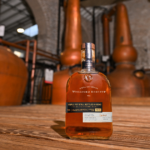
Stills designed and put into place by an American chemist named Duncan Thomas. The stills are technically pot stills. Fully made of copper as all pot stills must be, Loch Lomond has two sets of these. One set with cooling rings and one set without.
Those long copper necks allow for so much reflux of the spirit. Liquid turns into gas and as it recondenses into liquid, it falls back down and has so much more copper contact to make a lighter, fresher style of new make spirit that is used for all of the Loch Lomond brands.
Quick whisky question
Single malt is everywhere, but what does it mean? We want to know what the word “single” means to you. Three quick questions, under a minute.
They have a high collection strength of 85% when it comes to unpeated and highly peated spirit, as well as a low collection strength of 65% when it comes to peated, medium peated and highly peated spirits. Maximum flavours for as much vatting and blending as you need.
Roots Tracing Back To Littlemill, Scotland’s Oldest Distillery
The distillery of Loch Lomond can be traced back to a distillery expansion from Littlemill Distillery, again with Duncan Thomas at the helm. Littlemill was founded in 1772 and Loch Lomond as we know it opened in 1965 with the aim of being a distillery that could produce a lot of different distillates. Those straight neck stills mentioned above were created and originally used at Littlemill before being moved to Loch Lomond. Littlemill had some remarkable experiments in its history that helped develop Loch Lomond into what it is today. Duncan Thomas coated the pot stills in aluminium at Littlemill and used rectifying columns instead of swan necks on those pot stills, that’s pretty crazy.
Littlemill was eventually closed for the final time in 1997, before being sadly destroyed by a fire in 2004. Littlemill’s whisky casks and heritage passed over to Loch Lomond to help tell its very old origins and very experimental ownership.
What Will Whisky Look Like in 2027? Voices from Whisky Live Paris
READ THE STORYEleven Different Spirit Styles
With a total output of 20,000,000 litres of grain whisky and 5,000,000 litres of malt whisky, Loch Lomond really utilises all of these outputs for a maximum diversity of flavour profile. We’ve listed all of the different spirit types the distillery produces below, but Loch Lomond has so much more going on behind the scenes than any ‘typical’ whisky distillery.
1 to 3 – Traditional Swan Neck Pot Stills (67%) – Unpeated, Medium Peated and Highly Peated Spirit.
4 & 5 – Straight Neck Pot Stills – High Collection Strength (85%) Unpeated & Highly Peated Spirit.
6 to 8 – Straight Neck Pot Stills – Low Collection Strength (65%) Unpeated, Medium Peated & Highly Peated Spirit.
9 & 10 – Continuous Copper Column Malt Stills (85%) – 100% Malted Barley – Unpeated & Peated Spirit.
11 – Continuous Grain Stills (94%) – 95% Wheat and 5% Malted Barley Spirit.
A Multiple Award Winning Distillery
The distillery has collected well over 100 individual medals and titles over the years, two particular highlights being 2023 and 2024.
In 2023, Loch Lomond walked away with over twenty one separate awards for their core single malts, single grain and blended malt releases.
In 2024, they picked up sixteen awards, including a prestigious Platinum Medal for their Inchmoan 12 Year Old, 46% – easily my favourite of their core release single malts.
That year also included seven Double Gold Medals, four Gold Medals, four Silver Medals and an award for Best Single Cask Scottish Whisky with their Cask 21/546-6 First Fill Bordeaux Hogshead release.
On Site Cooperage
One of only four distilleries to have a cooperage on the distillery grounds. Loch Lomond unlocked another level of quality assurance, consistency and experimentation when it comes to their whiskies.
They can assess all the casks that enter their premises, de-char casks with their machinery, re-char them with their rather large onsite flamethrower, and then fill them with one of any of those eleven different spirit types.
Even with the distillery only existing since 1965, the lineage of the people that have passed through its doors spans generations of families, and that’s just when it comes to their coopers.
Final Thoughts
This distillery encompasses so much about whisky drinkers from all over the world. If you want an easy going malt, grain, blend or blended malt – this place can create that for you.
However, if you want to deep dive into some of the craziest, most interesting, and relatively short distillery history of any location in Scotland, Loch Lomond encapsulates the modern whisky drinking experience better than so many others around it.
 Latest On The Whiskey Wash