

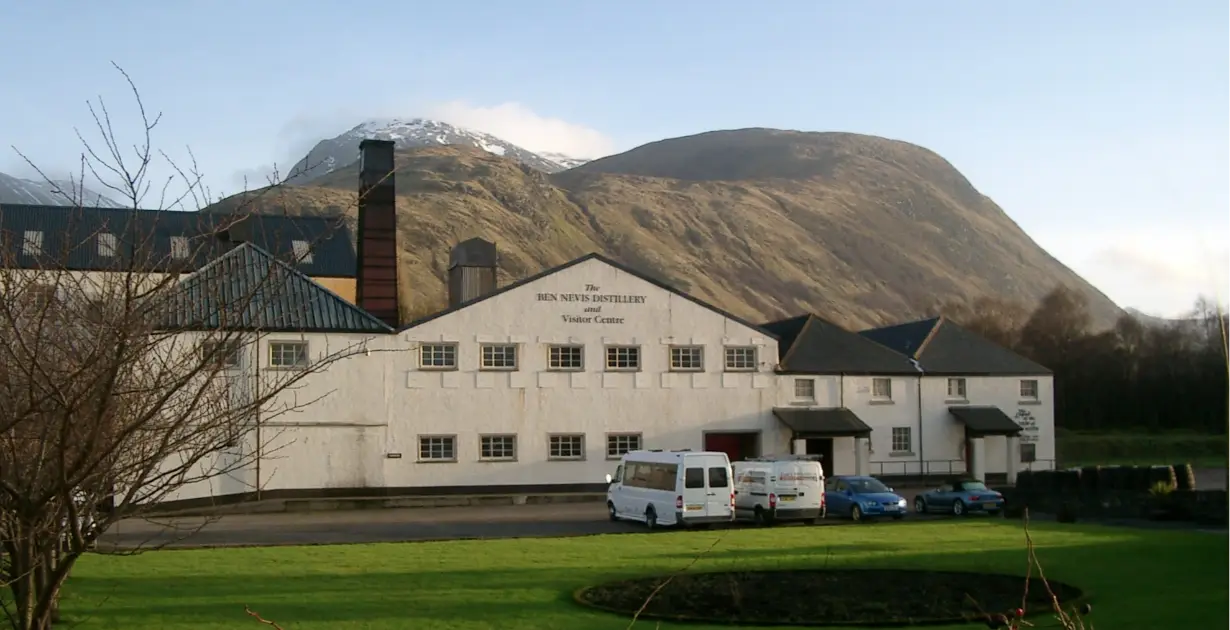
Picture a whisky distillery and you probably imagine something like Ben Nevis: a cluster of buildings at the foot of Britain’s tallest mountain, just outside the Highland town of Fort William.
Founded in 1825, Ben Nevis is one of Scotland’s oldest licensed distilleries. Look closer and the tidy timeline frays: records disagree on who built it, when royalty came calling, and what exactly was made on the site over two centuries.
What follows are five facts that rarely make the brochures: a vanished sister distillery, a mountain-rescuing giant with a flair for publicity, a Victorian malt brand ahead of its time, a bootlegger’s bizarre experiment, and a quiet thread running straight into Japanese whisky.
What Will Whisky Look Like in 2027? Voices from Whisky Live Paris
READ THE STORY1. It Was Once Two Distilleries, Not One
The single distillery you can visit today is the surviving piece of something much larger. In the late 19th century, Ben Nevis stood alongside a separate, purpose-built sister plant simply called Nevis.
The expansion came down to demand. As sales soared, Donald MacDonald built a new distillery alongside the old one in 1878 and called it Nevis. He took an unusual hands-on approach to its construction. He designed many of the buildings himself, using concrete where possible, and laid out a bustling village to house his employees and their families.
This was not a modest extension. Historic Environment Scotland records Nevis Distillery as a large complex of one, two and three-storey buildings, including a two-storey malting block with two truncated pyramidal-roofed kilns.
 Trending Content

The scale of the workforce tells the same story. When Alfred Barnard visited in 1886, he recorded 30 men employed at Ben Nevis and 200 more at the new distillery, with many working on shared services such as warehousing, coopering and carting. The newer plant had also overtaken its parent. The original distillery was producing more than 150,000 gallons of malt whisky a year, while Nevis was turning out over 250,000 gallons.
The good times did not hold. As blended whisky took over the market, Nevis Distillery closed in 1908 and never reopened, though its warehouses stayed in use until they were demolished in the 1990s.
So the place at the foot of the mountain is a fragment. What looks like a small Highland distillery is the last working trace of a near-vanished whisky town.
2. ‘Long John’ Was a Mountain-Rescue Celebrity and Marketing Genius
The man who gave the brand its name was hard to miss. John MacDonald stood around 6ft 4in, which earned him the nickname Long John and helped make him a Highland character long before he was a whisky icon.
His fame ran beyond the still house. By the 1850s, Long John was effectively the leader of the local party that rescued climbers in trouble on Ben Nevis. One story did particular work for his reputation. Newspapers in 1838 spread the tale of his rescuing the young Duchess of Buccleuch from the mountain, bringing her down on horseback using his plaid as a saddle.
That blend of spectacle and aristocratic connection was good for business. Long John tied elite customers and dramatic mountain stories to his whisky, and the brand’s early reach outstripped what its remote setting should have allowed. He also pulled off a famous publicity stunt by gifting a cask to the royal family.
Here the record gets slippery. The myth, repeated in plenty of marketing, credits Long John with founding the distillery in 1825. The documentary trail tells a different story. Whisky historian Iain Russell argues the distillery was originally built by Angus McDonnell in 1825, with Long John becoming a partner in 1830 and sole owner in 1831.
So the founder you read about on the label may not be the founder at all. Long John inherited a working distillery and turned it into a name, rather than building it from scratch.
One word of caution for readers who like their history airtight. Several of the most colorful anecdotes, including the duchess rescue, currently rest on secondary accounts that draw on old newspapers rather than clippings you can easily check yourself. The legend is strong. The paper trail is still worth chasing.
3. Its ‘Dew of Ben Nevis’ Was a Victorian Single-Malt Pioneer
It is easy to assume single malt is a modern phenomenon, a product of late-20th-century marketing. Ben Nevis suggests otherwise. The distillery was building a branded, premium malt long before single malt became a household phrase.
By the second half of the 19th century, the brand was already established. Before the end of the 19th century, Ben Nevis was producing one of the first branded single malts, Long John’s Dew of Ben Nevis.
What makes the brand feel surprisingly modern is how it was sold. The whisky was sold with age statements ranging from five to eleven years, and promoted as pure and unblended. Age-stated, single-origin and purity-led, it ticked boxes that today’s drinkers would recognize instantly.
There were even early signs of anti-tampering packaging. A Morning Advertiser advertisement from 1850 points to bottles protected by patent metallic capsules, a detail that suggests the brand was working hard to reassure buyers the contents were genuine at a time when adulteration was a real concern.
One note of care is worth adding. “Single malt” is a modern regulatory term with a precise legal meaning, so it is more accurate to describe Dew of Ben Nevis as an early branded pure Highland malt that later came to be understood as part of single-malt history.
The label matters less than the intent. Ben Nevis was selling a named, aged, unblended Highland malt to consumers who wanted to know exactly what they were drinking. The modern single-malt boom had a Victorian rehearsal, and Ben Nevis was on the stage.
4. It Became a Malt-and-Grain Hybrid Under a Bootlegging Canadian
The strangest chapter in Ben Nevis history belongs to Joseph Hobbs, a Canadian businessman with a colorful past. Between 1955 and 1981*, Ben Nevis was owned by the Canadian businessman and former bootlegger Joseph W. Hobbs, who supplemented the distillery with a Coffey still.
Hobbs had made his name during the Prohibition era. After the repeal of Prohibition in 1933, American companies rushed to secure supplies of Scotch to import legally to the US, and Hobbs and two partners set up Associated Scottish Distillers to help them.
His Ben Nevis experiment broke with normal practice. In 1955, Macnab Distilleries acquired the Ben Nevis Distillery, and Joe installed a Coffey still and began making both single malts and grain whiskies there. He went further still. He claimed that by blending his whiskies on site and allowing them to marry for long periods in the wood in his warehouses, he was able to produce superior blended Scotches to those of his competitors.
The result was a technical oddity. This made Ben Nevis one of the first Scottish distilleries to produce both malt and grain whisky on the same site. The “first in Scotland” claim should be treated as provisional. Some sources go further and call it the first in the world, while others use more guarded wording, so the superlative is worth holding lightly.
Hobbs left other marks too. He fitted Ben Nevis with concrete washbacks, which Nikka later removed during refurbishment, and legend has it he moved the Nevis distillery gates to Ben Nevis, which is why the current gates are not big enough to meet when closed.
The hybrid era did not survive him. Long John International, a subsidiary of Whitbread & Co., bought the distillery in 1981 and dismantled the Coffey still.
5. It’s Quietly Woven Into Japanese Whisky History
The most surprising twist in the Ben Nevis story is also the most modern. The distillery at the foot of a Scottish mountain now sits inside a Japanese whisky empire. Ben Nevis joined Nikka in 1989, as part of a Japanese-Scottish partnership.
The connection runs deeper than ownership. Ben Nevis spirit has physically traveled to Japan and ended up in a Nikka bottle. The company says so itself.
Look at the backstory of Nikka’s Coffey Malt and Ben Nevis appears in the small print. Although the whisky is now distilled in Nikka’s own Coffey stills, part of the older batches in the formula came from distillates imported from Ben Nevis and then redistilled in those stills as past experiments.
This creates an unusual category problem, and Nikka does not hide from it. The company also publishes the standards for what qualifies as Japanese whisky. Those standards require the water and all production stages to be carried out in Japan, and Nikka notes that Coffey Malt does not meet all the current Japanese-whisky criteria.
It is a rare thing to see a producer flag the limits of its own national labeling. The honesty is part of what makes the story worth telling.
So the thread that began under Britain’s highest mountain in 1825 now runs all the way to Japan and back. Ben Nevis is not simply a Scottish distillery with a Japanese owner. Its spirit is woven, by Nikka’s own admission, into the history of Japanese whisky, while sitting just outside the strict definition of it.
For a distillery this old, that may be the strangest fact of all. The friction in the record did not stop in the Victorian era. It is still being written today.
Myth Versus Record: A Quick Guide
A few Ben Nevis facts remain genuinely contested, so here is where the sources part ways.
Who founded it? The official distillery history credits John “Long John” MacDonald with the 1825 founding. Whisky historian Iain Russell argues the distillery was originally built by Angus McDonnell in 1825, with Long John becoming a partner in 1830 and sole owner in 1831.
The royal cask and Queen Victoria. The official timeline dates Queen Victoria’s visit to 1847, while the Edinburgh Whisky Academy places the royal-cask stunt in 1848. The dates do not align cleanly across accounts.
First dual-operational distillery? The official site says Ben Nevis was “one of the first” to make malt and grain at once, while ScotchWhisky.com calls it Scotland’s first dual-operational distillery. Some sources go further still and claim a world first. The superlative is best treated as provisional.
A Distillery Worth Knowing
Pull these five threads together and Ben Nevis stops looking like a pretty stop on a Highland road trip. It is a survivor of a vanished industrial world, the last working trace of a near-vanished whisky town.
It was shaped by a publicity-savvy giant who turned mountain rescues and royal casks into a brand, and later by an eccentric Canadian bootlegger who made it a technical oddity. Now it lives a second life inside a Japanese whisky empire, its spirit woven into Nikka’s own story.
The friction in the record is the reward. Next time a glass of Ben Nevis crosses your path, taste the history in it.
Which fact surprised you most? Tell us in the comments.
*Joe Hobbs died in 1964. After his death, his son (Joe Hobbs Jr.) and his company, Macnab Distilleries, continued to run it until the sale to Long John International in 1981