

Craft distillers often complain about the Federal Standards of Identity for Distilled Spirits (27 Code of Federal Regulations 5), a set of labeling rules enforced by the Tax and Trade Bureau (TTB) of the Treasury Department. These regulations define which spirits can be called what names.
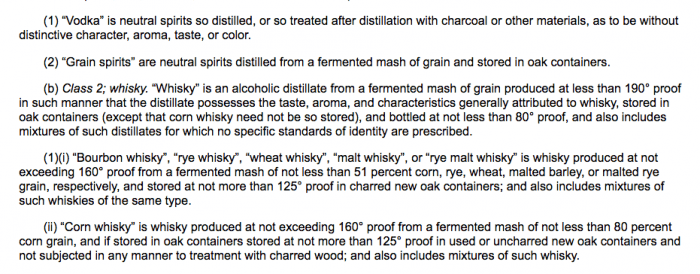
Source: ELECTRONIC CODE OF FEDERAL REGULATIONS
Small producers complain that the rules are outdated, squelch creativity and should be changed. The TTB recently invited them – through their trade association, the American Craft Spirits Association – to suggest revisions ahead of the effort this fall to update the regulations. Who knows – maybe we’ll end up with new categories, like barrel-aged gin?
This isn’t the first time producers have asked for changes. It’s worth recounting what happened the last time producers demanded that regulators redefine whiskey. It is a cautionary tale.
Forty years ago, the most powerful companies in the distilled-spirits industry pushed for a sweeping set of revisions to the rules regarding whiskey. There were no microdistilleries then, but the relatively small, family-owned distilleries that specialized in straight bourbon, straight rye and Tennessee whiskey opposed the changes.
It was a battle between modernizers and traditionalists. And tradition won.
The changes were proposed in response to foreign competition. The argument was that Irish whiskey and the whiskys of Scotland and Canada had significant cost advantages over American whiskey. The imports generally were distilled at much higher proofs, entered into barrels at higher proofs and aged in used barrels.
American producers could make a similar product, but the rules required them to label it in ways that diminished its marketability. There were certain terms they were not allowed to use in regard to such a product, such as “straight bourbon whiskey” and “straight rye whiskey.” There also were certain other terms they were required to use, such as “aged in used cooperage.” The imports merely had to be labeled here the same way they were labeled in their home countries.
The big companies wanted the feds to change the rules so they could make American whiskey more in the foreign style, but still label it the American way. Specifically, they wanted the top distillation proof raised from 80 percent alcohol by volume (ABV) to 95 percent ABV. They wanted no maximum barrel-entry proof, which had been capped at 62.5 percent ABV. New charred oak barrels would not be required.
 Trending Stories

They also wanted to relax the standard for straight whiskey (and the various types thereof) to permit blends of of different types to be labeled as straight whiskey without the words “blend” or “blended” appearing in the designation. One petitioner wanted a new rule requiring a minimum aging period of two years; another proposed a four-year minimum, following foreign practice.
In January 1968, the agency rejected most of the proposals and explained its reasoning in a nine-page industry circular (No. 68-03).
The agency ruled that spirits made in the proposed way would “generally lack the distinguishing characteristics of such whiskies.” To call these products “straight bourbon” or “straight rye” would be misleading and not “in the interests of the consumer.” The agency found that higher distillation proof “produces a distillate containing less pronounced natural flavoring components (both desirable and undesirable ones).”
On the minimum age-requirement proposals, the agency observed that, “there are no appreciable amounts of immature whiskies currently being sold,” a statement that is not true today. However, they did note “the present regulations protect the consumer by requiring all whiskies less than four years old to bear a true age statement.” That is still true, although enforcement has been lax.
Most surprising about the 1968 circular is the extent to which the agency concerned itself with the balance and flavor of American whiskey. Regulators usually insist their sole interest is truth-in-labeling, not quality, per se. That does not appear to be the case here. Perhaps tasting was involved.
Regardless, we should be glad they did. Playing follow-the-leader and making American whiskeys more like foreign whiskeys would have failed in the long run. People want distinct, high-quality choices.
Keeping the legal standards for our whiskeys high is what has made American whiskeys so good and so heavily demanded. American whiskey is booming and exports are soaring year after year.
Hopefully, the TTB will keep this in mind, as it tries to figure out how best to define the various types of spirits.
Editor’s Note: This article on whiskey labeling first ran on the R Street Institute Blog.

 Latest News